

Duncan Clarke*
Countries do not ordinarily just disappear even if they no longer inhabit the minds of cartographers and appear no more on world maps.
States may change governments, formal state boundaries, legal forms and constitutions, foreign policy allegiances, even ideology, and sometimes their names, but their existence generally survives in the geography, historical consciousness and collective imagination of the world.
Just as often, empires can dissolve or collapse, colonies may outlive empires to become independent, while kingdoms can become republics, and political regimes if constitutional republics normally surrender to legitimated successors.
Residual imprints of any former state usually remain evidently recognisable, whether in inherited institutions, among its inhabitants, or defined by territorial identity, and just as often by place and culture lodged in historical memory.
The End of Pax Rhodesiana
Rhodesia presents a different and unusually revealing case. On 18 April 1980, the land known to generations of its inhabitants as Rhodesia ceased to exist under that historic name. Zimbabwe emerged overnight as the inheritor state. Based on the same territory, it proclaimed a profoundly different myth, origin, ideology, political legitimacy, national identity and implied historical destiny.
This sudden transition represented ‘liberation’ and majority rule for its African peoples, but for many Rhodesians it marked the extinction of the only country they had known as home or in conventional history since 1890, even for six-to-seven generations.
What disappeared was not the highveld land, nor its modern towns, the lowveld and its river basins, or mountain ranges in the Eastern Highlands, commercial farms, abundant flora and fauna, and the vast savannah landscapes. Nature’s bounty remained.
Nor did the histories of its diverse ethnic peoples, whether as autochthons or immigrants or Rhodesians, begin anew in 1980. All had separate or combined histories in legacy or mind, some stretching back to the Stone Age, Rhodesians back to the era of Robert Moffat in the mid-1850s and the pre-Rhodesians such as Frederick Selous and Thomas Baines before the Occupation in1890.
What first eroded then and vanished in large measure was a particular political, socioeconomic construction, an organised culture and its modern society, with long-established state institutions and in-place political economy, governing laws, public statues and symbols, heritage and assumptions, loyalties and long-held conceptions of its ninety-year history and established identity.
Already trading under the ersatz rubric of Zimbabwe-Rhodesia since mid-1979 towards the end months of the bush war that had begun 16-years earlier, the Rhodesian state was summarily extinguished de jure, notwithstanding an earlier but brief three-month inter-regnum of assumed British sovereignty under the edict of an appointed Governor of ‘Southern Rhodesia’, Lord Christopher Soames. Yet its embedded historical record and prior existence could neither be erased or abolished nor entirely forgotten. That was an inexorable reality.
Yet Rhodesia’s disappearance was not some single event confined to 18 April 1980. It was, and remains, an extended historical process, long in the making: a systematic and progressive retreat from history, political geography, public recognition, institutional continuity, minority cultural prominence in its once-founded state, and ultimately excision from the world’s collective imagination.
Yet this long-term process of eclipse and erasure has been neither complete nor uncontested. Rhodesia still survives as an historical subject, if a disputed bequest or inheritance, as an assemblage of memories and within the minds of its widely dispersed populace of exiles who have retained their cultural identity.
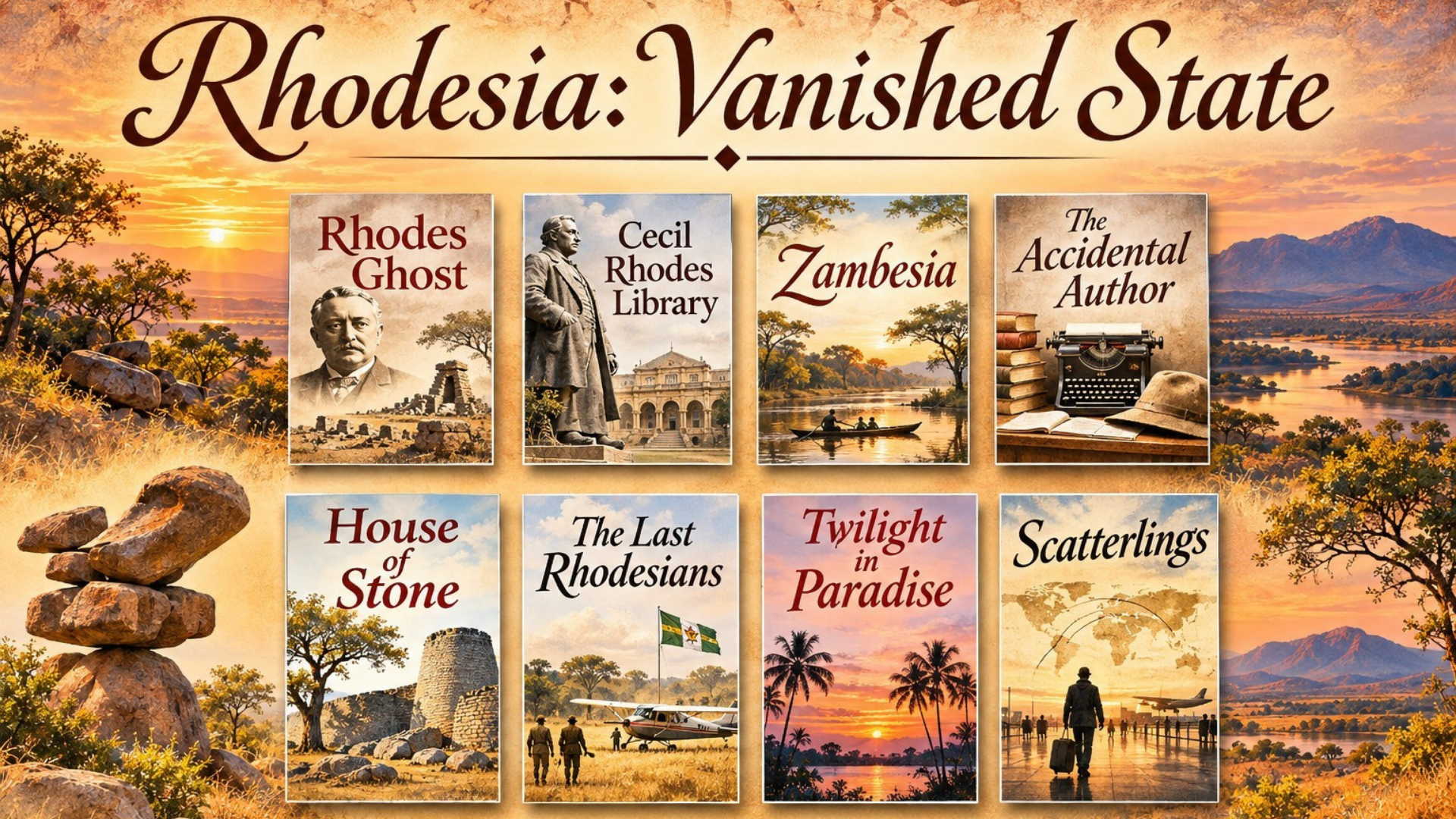
Herein lies the central paradox: while this country ceased to exist politically, it continues to inhabit the minds, conversations, literature, private thoughts and memories plus social worlds of hundreds of thousands of Rhodies scattered across the globe, now resident in over sixty countries on five continents, as has been detailed in Scatterlings: Rhodesians Worldwide.
Indeed, Rhodesia’s history and existence is denied neither by its detractors nor its custodians, although their interpretations of what it represented is often one apart if not sometimes irreconcilable. Rhodesia is thus paradoxically often both absent and present, erased or extinct, yet still well remembered, condemned or commemorated. Its historical meaning remains unsettled long after its political fate was decided.
Eclipse and Erasure
The disappearance of Rhodesia cannot be understood without acknowledging the extraordinary circumstances of its origin, evolution and eventual demise.
The land associated with Cecil Rhodes and the British South Africa Company began as a distinctive settler society in landlocked Central Africa, first under the Company’s administration, subsequently as Southern Rhodesia in 1923, then in the ill-fated Federation of Rhodesia and Nyasaland, 1953-63. Eventually, it emerged as the contested political regime of Rhodesia after UDI in 1965, and as the self-declared Republic in 1970. Yet for most decades from origin, it was simply known by the epithet, Rhodesia. Indeed, that was evident even in the 1890s as I have written in Rhodes’ Ghost: The Conquest of Zambesia.
Over the nine decades of its existence, Rhodesia developed its own culture and society, state institutions, modern economy, markets and professions, social conventions, sporting traditions, literature, military bodies, culture and unique social nexus with a deeply felt sense of national ethos and identity.
Rhodesians were never more than a small minority of the country’s inhabitants, but they exercised disproportionate influence over its political, economic and cultural institutions. To most observers, even critics, Rhodesia emerged as an organised, efficient, functioning, productive and increasingly self-reliant society, despite international sanctions imposed after UDI and during the hard years of growing insurgency. That combine acted to bring illegitimacy to the Rhodesian state and an end to its de facto and de jure existence.
Yet any state may lose its legitimacy without inhabitants losing their memories. Its political institutions may disappear without extinguishing the individual lives and memories of its inhabitants, their record of achievements and attachments accumulated among them. It is precisely this difficult territory, along with the state’s erasure and the survival of Rhodesian identity, that needs recognition.
How then did this happen – and in such relatively rapid fashion?
The excision of Rhodesia from contemporary cartography and mapping was almost immediate. Its retreat from ordinary international discourse was slower, more selective and more complicated, as were the changed circumstances of its once dominant political culture, as I have noted in The Last Rhodesians: Society Adrift.
In rapid fashion, street names changed. Flags were lowered and replaced. Official regalia and emblems disappeared. Public institutions were reconstituted or renamed. The many symbols and vocabulary of Rhodesian nationalism were displaced by those of Zimbabwean independence and its liberation mythos.
Rhodesia’s political and social history increasingly became another chapter to be much revised within the far larger curated narrative of settler colonialism, nationalism, liberation across Africa and postcolonial statehood. For emergent generations around the world, Rhodesia gradually but inevitably became an historical reference rather than remembered reality or the displaced pawn of the shifting puzzle around Africa’s complicated geography in the Cold War’s geopolitics and chessboard.
Many now only encounter Rhodesia through discussions of white minority rule, international sanctions, the bush war, Ian Smith or the fraught history of African decolonisation. But erasure from everyday recognition is not the same as the state’s dislocation from academe, history or scholarship – or even the minds and memories of most surviving Rhodesians.
Rhodesia remains the subject of on-going if substantial academic enquiry even if far less the case than before, including in public or political criticism, historical investigation, published memoir, occasional film, documentary production and digital discourse. Indeed, the persistence of controversy and argument over its contested past has helped paradoxically preserve its nomenclature. Rhodesia may have thus disappeared as a political entity, but it continues to occupy a conspicuous, if more narrowly defined, place within contemporary history and argument.
There have also been several forms of excision or erasure: the extinction of the state, the displacement of its former identity and dominant culture, its declining public familiarity in the wider world, erasure of its historic name, the systematic dispersal of most Rhodesians, and the eventual final loss of its living witnesses. These processes are neither identical nor necessarily simultaneous.
There are several possibly measurable dimensions of historical disappearance. For instance, what became of this vanished country in encyclopaedias, school textbooks, libraries, university research, newspapers, film archives and the digital public square? How has its public image changed across the generations since its elimination? Does Rhodesia survive today primarily through criticism, nostalgia, specialist scholarship or in the custodianship and cultural retention of memory and writings by its former inhabitants?
Perhaps the most remarkable consequence of Rhodesia’s extinction as its own state was the dispersal of much of its former white population. Emigration had occurred before independence and continued afterwards, inexorably, driven by political uncertainty, insecurity, Africanisation, family circumstances and, in later decades, by Zimbabwe’s successive political and economic crises, as induced by corporate asset takeover, land confiscations, the Third Chimurenga and serial hyperinflations. Exile thus manifested in exodus, that turned over the last five decades into an unfolding long-term ethnocide.
The result has been an extensive international exile world of ex-Rhodesians and their descendants established across South Africa, or elsewhere, and in Britain, Australia, New Zealand, North America, Europe, the Gulf, Asia and other far-flung parts. That dispersal has produced an historical inversion.
The territory once called Rhodesia, as were once Rhodesians, remained fixed in southern Africa, while the arc of history enforced over 90 per cent of them to become exiles from their homeland, leaving but 15 000 or so in situ, as I have described in Twilight in Paradise: The ‘Left Behind’ Rhodesians. That identity, once deeply attached to the specific ‘land between the rivers’, Zambezi and Limpopo, and its political economy, became detached from both.
Yet the Rhodesian culture survived through interconnected family relationships, friendships, memory, recollections, sporting links, and school reunions, military bodies, social associations, published literature, private correspondence, public commemorations and the extraordinary connectivity later occasioned by the internet and modern digital world. Thereby, the remembered country acquired another geography extending beyond its former borders that reached far into and across cross-continental spheres.
Scatterlings: Rhodesians Worldwide traces that geography of memory and remembrance, identifying the locations, networks and institutions through which Rhodesian identity was transmitted and sustained. It records how that culture retained its collective identity when deprived of its original territorial nexus, and how that identity became stronger, or weaker or simply different with the passage of time or the passing of generations.
While the nature of exile was not a uniform condition, a myriad of circumstances shaped its alien world. Many ex-Rhodesians departed reluctantly, others did so willingly. Some prospered elsewhere, others encountered severe material cost or emotional losses. There are many who maintained an enduring affection for their former homeland while a few others have distanced their affinities from their past political, social, ideological and cultural inheritance.
Nor were all Rhodesians politically alike, and their exile world does not inhabit any single or uniform political constituency. It’s a collage of individuals carrying different memories of their old country, the erasure of which they experienced in different ways. Still, many commonalities exist among them in history, identity, lingo and modes de vie as to enable one and all to reflect generic and similar cultural manifestations.
The dissolution of the Rhodesian state and its political identity also possessed an economic history. That transformation and Zimbabwe’s many later economic upheavals affected incomes and wealth, assets, farm and property ownership, corporate interests, commercial networks, professional opportunities, pension arrangements and once-inherited expectations about old age and security.
The consequences were uneven, extending across social divisions, urban and rural milieux, and arising at varied moments for different generations and exiles at specific times of exit. Those conditions and dilemma were discussed in The House of Stone; An Unwritten Story, the saga about Zimbabwe’s last fifty years.
For many emigrants, departure involved the abandonment, sale or progressive erosion of private assets, often accumulated over generations, even direct loss. Others transferred professional skills, corporate savvy, human capital, funds and investible assets into their adopted countries, reconstructing their careers and firms in unfamiliar worlds. The economic consequences of Rhodesian exile cannot thus be measured solely by what was lost within Zimbabwe, or even what was lost within one generation.
The economics of disappearance or loss extended beyond balance sheets. It involved the loss of home and place, the cost of resettlement outside Rhodesia, or later Zimbabwe, and the distinction between changed net material prosperity and the enduring psychological or social cost of the lost homeland.
Custodians of Memory
If Rhodesia still survives as a remembered country, its continued afterlife and existence owes much to those Rhodesians, most abroad, but some remaining at home, who have preserved memory and curated its extant historical record.
Authors, historians, journalists, publishers, artists, photographers, documentary and filmmakers, archivists, collectors, veterans, family chroniclers, bloggers, digital creators or nomads have assembled and make available an extensive, if globally fragmented, residual inheritance of traditional Rhodesiana.
Books, photographs, private diaries, letters, maps, military records, sporting memorabilia, films, music, YouTube clips, Facebook postings, art, paintings and domestic artefacts have become the repositories of this once vibrant society but now vanished country.
Some private collections have been meticulously curated or researched; others are selective, sentimental or even in cases politically partisan. Some illuminate neglected aspects of what everyday life had been, while others reproduce the assumptions, ideas, values and silences of the lost social milieux.
The distinctions matter. Memory is not history, although memory supplies much of history’s raw material. Nostalgia may preserve details otherwise forgotten, but it may also simplify, idealise or exclude fragments of the lost past. Equally, political theses and social histories may illuminate historical truths while also neglecting the complexities of individual experience.
Scholars examining digital images or representations of the Rhodesian bush war have demonstrated the continuing significance of that remembrance as a subject of investigation. Other scholarship has also interrogated the relationship between Rhodesian nostalgia, national identity and then contemporary social life and politics. Such work forms part of the Rhodesian historical inheritance.
The continuing availability of earlier Rhodesian historical publications, including the journal Rhodesiana, under its new rubric Heritage, illustrates how archival content and continuity has survived changes of political status and institutional nomenclature. The same applies to the History Society of Zimbabwe and works now digitised and made available on the website for Rhodesians Worldwide or others.
Some Rhodesians both at home or outside have acted as the custodians of memory, and their contributions and significance can be situated in literature and the broad bibliographical and cultural landscape. They should neither be canonised nor dismissed, but it behoves to establish what has been preserved, by whom, for whom, and with what enduring historical value.
The architecture of the vanished state need to follows the historical formation of Rhodesia to its political extinction, from the dispersal of Rhodesians to the preservation and survival of its cultural inheritance. In the latter lies the afterlife of Rhodesia portrayed in literature, archives, scholarship, books, films, family histories, memoirs, memorabilia, political criticism, the web and digital culture, as well as in widespread societal remembrance, revisionism, commemoration and critique, historical evidence and even in elements of inherited mythology.
In the fulsome arc of time lies the future and the demographic extinction of first-hand witnesses, the transformation of living memory into inherited identity, and the ultimate question of what Rhodesia may yet mean to those ‘born abroad’, generations for whom it will neither be their country or origin nor any manifest personal recollection. It is within and around those mechanisms through which states ultimately disappear, identities survive and historical meaning changes.
Fifty to One Hundred Years
The year 2030 will mark fifty years since Zimbabwe’s independence and the extinction of Rhodesia as a formal state designation, with its excision from the maps found in modern global cartography. While not an eon in time, one half a century is sufficient to transform the meaning of any historical event.
By then, most Rhodesians who experienced that era as mature adults will be more elderly or deceased. Those who knew it and recalled it as children will in time constitute the final generation possessing direct personal recollections of the nomenclature of the land that has disappeared.
Zimbabwe itself will then have passed through fifty years of post-independence, encompassing the long rule of Robert Mugabe, the political transition or coup of 2017, the presidency of Emmerson Mnangagwa in the Second Republic, and the economic, institutional and social consequences of post-1980 governance following the bush war and the end to Pax Rhodesiana.
Zimbabwe’s flaws, achievements, or ruptures demand assessment on their own terms, not merely as an epilogue to Rhodesia. The fiftieth anniversary will also provide an opportunity to consider what was inherited from the Rhodesian state, the economic bedrock that remains, what was dismantled, or deconstructed, or destroyed, what institutions survived and inheritances that were transformed.
Beyond 2030 lies an even more consequential transformation. By 2050, direct adult ‘Rhodie’ recollections of pre-independence Rhodesia will have become exceptionally rare. By 2075, the vanished state will probably survive principally through some inherited ideas, retained historical knowledge, literary works, family stories, retold narratives, archives and documentary records, institutional or private ‘grey literature’, and then remaining digital images or texts. By 2100, distinctions between Rhodesia as ‘once-lived experience’ and Rhodesia as historical reconstruction will be almost certainly absolute.
These dates are symbolic horizons for enquiry rather than predictions of cultural extinction. Collective memory does not erode only according to innate biological formula. Some families may be able to preserve identities across centuries; yet assimilation elsewhere may weaken cultural attachments within one or more generations. Even so, new technologies may perpetuate historical awareness long after the last witnesses have died, while changing political landscapes and social values may radically alter access and the meanings attached to the past.
This is why an examination of the demographic future and cultural trajectory of Rhodesian memory is of significance. Who will remember Rhodesia in 2050? What will their descendants understand by the term in 2075? Will Rhodesiana remain as recognisable cultural inheritance in 2100, or have become another rare if specialised historical curiosity? Might the large and fast growth seen in digital preservation create a more extensive archive than ever existed during Rhodesia’s lifetime, even as personal identification with the state diminishes?
Future trajectories may preserve several forms of Rhodesiana at the same time: the Rhodesian state in historical scholarship, the memories of Rhodesia in family histories, the contestations about Rhodesia in world public debate, and the more remote Rhodesia identifiable but secreted in residual archival records.
These themes are ultimately larger than Rhodesia per se, or its lost place on the world map. They concern the relationships between territory and identity, history and belonging, and even about amnesia with collective remembrance.
It is worthwhile to ask for how long Rhodesia as the country-lost can continue to exist culturally after its political extinction, whether memory can survive the absence of its last witnesses, and if the social histories of displaced Rhodesians can exist as extensions beyond the state with which they were associated.
Rhodesia provides an unusually concentrated instance of these dilemmas. Its existence was brief by the standards of nations, but not necessarily of those in Africa. It was the first Westphalian state formed below the Tropic of Cancer in sub-Saharan Africa. It endured for twice as long as had Zimbabwe by 2025. That ‘newly created’ African state will reach Rhodesia’s vintage only in 2070.
Equally, Rhodesia’s political foundations, history, status and legitimacy have been contested like no other, certainly so in Africa – from critique of its founder, Cecil Rhodes, to multiple state incarnations 1890-1980.
Rhodesia’s fall and relatively sudden demise was internationally consequential, as portrayed in Discontents: An Historical Expose, which identifies the tens of thousands of critiques about Rhodes, Rhodesia and Rhodesians made over the last 140 years, a tome expected in mid-2027- yet the subsequent cultural survival and afterlife of Rhodesians have been remarkably persistent, globally spread, and remain an unfinished story.
Given that almost unparalleled critical onslaught, it is worthwhile to explain how an entire political, economic and social world can disappear from the map of Africa and world cartography while leaving behind the indelible marks of lasting track records, retained memories, an economic bedrock, residual institutions, and sustained identities that continue to shape lives far beyond the former borders of the land Rhodesians once inhabited.
Rhodesia qua state cannot return. Most generations who inhabited it cannot, or will not, either. Many material traces of the past have changed, its surviving witnesses will one day disappear, and remembered identity will in time become repeatedly reconstructed only by those who never knew it. Those dates are for now unknown, but such disappearance is not necessarily oblivion.
The epochal story of this lost country is not one that has been fully extinguished, even as most Rhodesians have since dispersed across the world. Despite that its historical inheritance is contested, its memory remains, along with its culture, and its ultimate destiny is as still unwritten.
Duncan Clarke, born in Salisbury, 1948, is the author of numerous books on Rhodesia and the fate of Zimbabwe, including Rhodes’ Ghost: The Conquest of Zambesia (2020); The Last Rhodesians: Society Adrift (2022); Cecil Rhodes Library (2024); The House of Stone: An Unwritten Story (2025); Twilight in Paradise: The ‘Left Behind’ Rhodesians (2026); and Scatterlings: Rhodesians Worldwide (due Dec 2026). Discontents: An Historical Expose (forthcoming 2027). For more, see www.duncan-clarke.com – duncan@glopac.com
Discover more from Africa Unauthorised
Subscribe to get the latest posts sent to your email.
