

Andrew Field
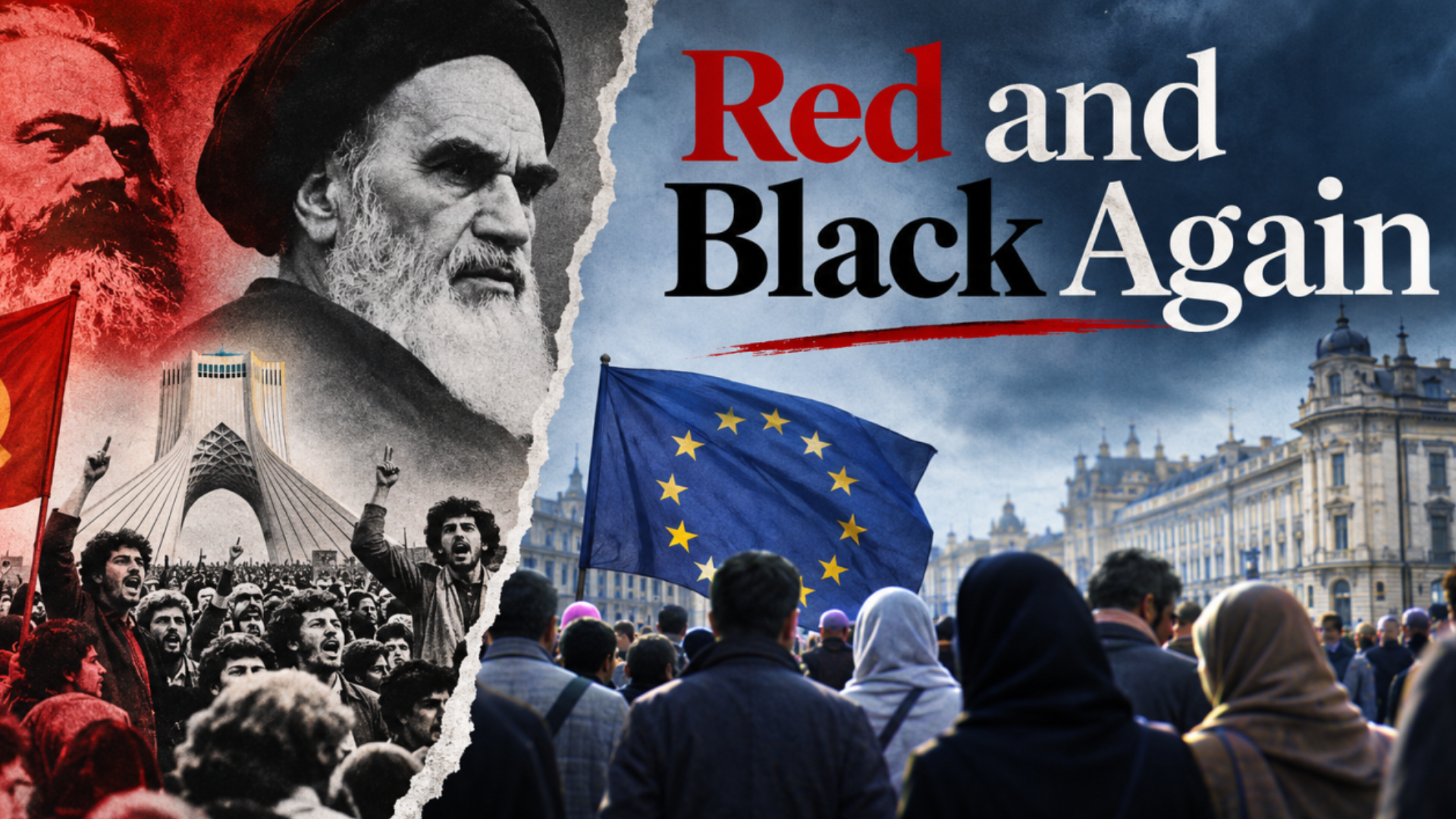
Years before the crowds filled the streets of Tehran, the Shah of Iran warned of a “red and black” alliance. The red was the Marxist left. The black was the mullahs. Western intellectuals laughed, and so did much of Iran’s educated class. By 1979 the joke had become a government. The revolution that toppled the Peacock Throne was never Khomeini’s alone. Clerics, liberal nationalists, students and the Marxist left marched together against the Shah. Each believed it was using the other. Within a few years the liberals had been sidelined, the left imprisoned or executed, and the clerics ruled alone. The red carried the black into power. The black repaid the favour with a rope.
That history explains why some of the sharpest warnings now come from Iranian exiles. Their parents watched the sequence unfold once already. Elica Le Bon argues that Western progressives still read the Middle East through a Marxist lens. Darya Safai relays the question increasingly heard among Iranian émigrés in Europe: “Where should our children flee to now?” The obvious objection is that Europe is not Iran. Of course it is not. Europe has no clerical hierarchy comparable to the Iranian mosque network of 1979. The churches have spent half a century retreating from public life. In England and Wales, Christians now account for less than half the population while the fastest-growing category is no religion at all. The contest is not between mosque and church. That battle ended long ago, and the church scarcely appeared.
The real contest is between conviction and indifference. Across much of Europe, Islam encounters societies that increasingly struggle to explain why their own values deserve preserving. The freedoms of modern Europe did not emerge by accident. The right to challenge authority, mock religious belief, abandon a faith, speak freely and associate freely was won through centuries of political conflict. Yet many of the institutions entrusted with defending those freedoms now seem uncertain that they are worth defending at all. A minority that believes intensely faces a majority that often appears unsure what it believes beyond personal comfort and administrative order.
This uncertainty is most visible in migration policy. Europeans are repeatedly told that the issue is one of humanitarian protection, yet the European Union’s own asylum statistics tell a more complicated story. Fewer than one asylum claim in three now succeeds at first instance, while only a minority of failed applicants are ever removed. The result is a system in which legal failure often carries little practical consequence. The problem is not capability. European states can control migration when they choose to do so. Britain drastically reduced legal migration through ministerial decisions while Poland combined large-scale legal labour migration with aggressive controls at its eastern frontier. The technical means exist. The political will often does not.
There is little evidence for grand conspiracies directing migration into Europe. The more useful question is not who created the flow but who benefits from it once it arrives. Islamist movements are among the clearest beneficiaries. Their strength does not derive from numbers alone. France’s investigations into Muslim Brotherhood networks suggest relatively small activist cores, yet organised minorities become influential when they acquire the ability to present themselves as representatives of much larger communities. Activists rarely require majorities. They require leverage. Perched atop larger populations, however diverse those populations may be, a disciplined minority can exercise influence far beyond its numbers.
That influence increasingly extends into public institutions. In Belgium, organisations criticised by state security services nevertheless received public funding. In Britain, public authorities have repeatedly flirted with definitions of anti-Muslim hostility broad enough to chill legitimate criticism of religion. Across Europe, officials often appear more concerned with avoiding accusations of prejudice than with confronting difficult questions of integration, parallel communities and social cohesion. The issue extends beyond Islamism itself. Sections of the political left increasingly view Muslim communities as important electoral constituencies. Businesses see labour for ageing societies. Lawyers find causes, charities find funding and bureaucracies discover new responsibilities. None of this requires conspiracy. Shared incentives often achieve what conspiracies never could.
The parallel with Iran is therefore not that Europe faces an Islamic revolution. Such comparisons are lazy and often hysterical. The parallel lies elsewhere. In 1979 every faction believed it was using temporary allies to achieve its own objectives. The liberals believed they could control the clerics. The left believed it could control the liberals. Both were mistaken. Europe’s coalition is broader and far less dramatic, but a similar confidence is visible. Politicians believe they can absorb large-scale migration without social cost. Businesses believe labour shortages justify the risks. Activists assume emerging voting blocs will remain loyal to progressive causes. Everyone assumes somebody else will bear the consequences if the calculation proves wrong.
Part of the explanation lies in what Pascal Bruckner called the tyranny of guilt. For decades Europe has taught itself to view its history primarily through the lens of colonialism, racism and oppression. Every civilisation contains crimes and failures worthy of examination, but a civilisation unsure of its own legitimacy struggles to defend itself. It struggles to demand assimilation from newcomers. It struggles to insist that its laws take precedence over communal loyalties. Sometimes it struggles even to explain why its customs deserve preservation. What begins as humility gradually hardens into paralysis, and paralysis eventually becomes policy.
That paralysis has often been reinforced by legal institutions. European human-rights law is usually portrayed as a creation of the progressive left, yet its origins are largely conservative. The European Convention on Human Rights owed much to post-war conservatives such as David Maxwell Fyfe. Only later did expansive judicial interpretations transform it into something more ambitious and politically contentious. A conservative child was raised by progressive nannies. Islamists learned to exploit the indulgence. Britain, increasingly frustrated by the consequences, has begun showing signs of throwing the baby out with the bathwater. Across Europe governments are now challenging judicial interpretations that limit migration enforcement, while parties of both left and right acknowledge problems that, only a few years ago, could scarcely be discussed without accusations of extremism.
Whether that shift comes in time remains unclear. Demographic realities cannot simply be reversed. Populations already established within European cities are not going anywhere, nor should they. The question is not demographics but influence. Influence was never achieved through elections alone. It was achieved through institutions, culture, law and administration. What politics created, politics can dismantle. Yet this leads directly to Europe’s deeper problem. Many citizens no longer believe ordinary politics can produce outcomes they repeatedly vote for. Across the continent the same pattern recurs. Electorates express concern about migration and governments promise action. Immigration continues. Voters demand enforcement and enforcement often fails to materialise. Courts intervene, bureaucracies delay and politicians explain why popular demands cannot be implemented. The lesson absorbed by the public is not moderation but futility.
Every political order rests upon an understanding that the state will perform certain essential functions, chief among them control of the frontier. A government that cannot or will not decide who enters its territory inevitably invites a more dangerous question. If the state will not defend the boundary, who will? That question is no longer confined to political fringes. It increasingly appears among ordinary citizens who suspect there is no constitutional mechanism capable of producing the policies they repeatedly demand. They are told they remain sovereign, yet discover that sovereignty appears to end precisely where their strongest preferences begin. Once a population concludes that the ballot box cannot alter policy, faith in democracy itself begins to decay.
The threat facing Europe is not the triumph of Islamism. It is the possibility that millions of Europeans may conclude that the existing order no longer represents them and no longer deserves their loyalty. Civil peace rests upon consent. It rests upon the belief that institutions remain responsive, that governments ultimately answer to voters and that grievances can still be addressed through law rather than force. Europe’s rulers spend much of their time worrying about the opinions of activists, clerics and pressure groups. They might pay closer attention to the mood of the ordinary citizens carrying the burden. History suggests that populations will tolerate many things. What they do not tolerate indefinitely is the belief that their country is slipping away while those responsible for its defence insist that nothing can be done. The democratic answer is assumed to be self-evident. The uncomfortable possibility is that an increasing number of Europeans no longer believe one exists. The consequences of that loss of faith are unlikely to be settled in a courtroom.
Guest writer, Andrew Field, is the founder and author of the chronicle South of the African Equator and photoblog Simply Wild Photography
Discover more from Africa Unauthorised
Subscribe to get the latest posts sent to your email.
