

By Andrew Field
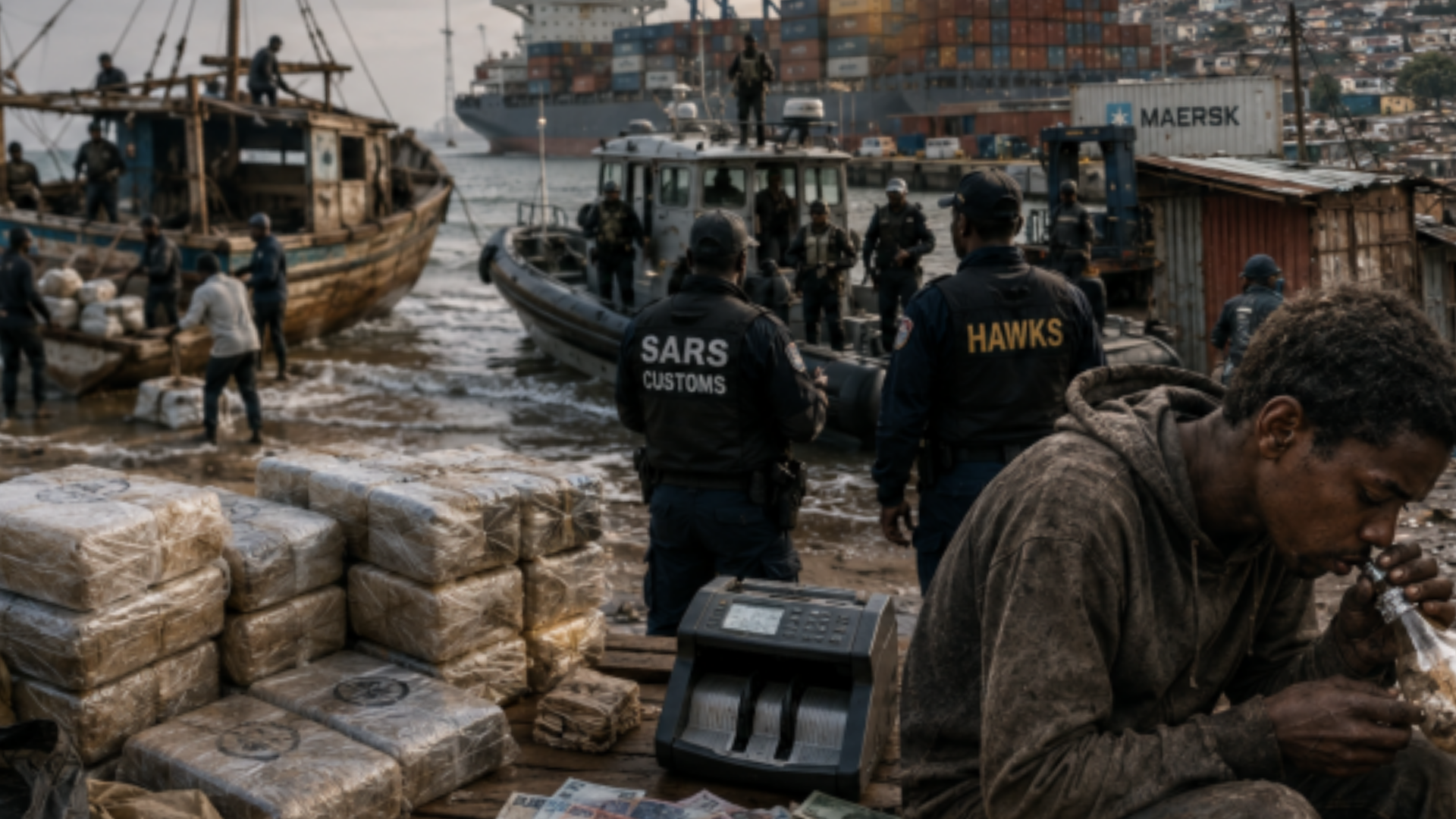
The new story of narcotics in southern Africa does not begin with a theory. It begins with seizures. In June 2026, Durban harbour again produced cocaine. One shipment was hidden in excavators from Brazil. Another followed days later: thirty bricks seized by South African Revenue Service (SARS) and the Hawks at the same port. In May, police in South Africa’s North West province uncovered an industrial methamphetamine laboratory at Swartruggens, with Mexican nationals among those arrested. Two years earlier, Groblersdal had already produced the same warning: South Africa was no longer merely receiving drugs. It was manufacturing them.
These busts are impressive. They are also misleading. They show that enforcement agencies can still intercept shipments, raid laboratories and parade contraband before the cameras. They do not show that the trade is under control. The more important question is not how many bricks were seized, but who was convicted above the level of courier, cook, driver or warehouse hand. On that test, southern Africa performs badly.
The African Southern Route has changed because the market has changed. The old heroin spine still matters: Afghan opiates move from the Makran coast across the Indian Ocean by dhow, land along the East African and Mozambican coast, then move south into South Africa for local consumption and onward export. But the Afghan opium ban of 2022 disrupted supply and forced adaptation. Heroin did not vanish. It was cushioned by stockpiles. Yet the traffic increasingly diversified into methamphetamine, cocaine and synthetic drugs. That is why the southern route is no longer only a heroin route. It is becoming a multi-drug corridor.
Brazilian cocaine enters through containerised maritime trade. Afghan and Pakistani methamphetamine travels along routes once associated with heroin. Mexican cartel expertise has appeared in South African laboratories. Mandrax, cannabis, codeine syrup and cheap synthetic intoxicants fill the lower end of the market. At the final point of social collapse sits the Zimbabwean youth user, inhaling mutoriro through a stripped light bulb.
The financial route is harder to see than the drug route, but it is more important. Drug money does not need romance. It needs property, cash businesses, transport companies, customs agents, clearing firms, nominee owners, offshore accounts and political protection. South Africa’s financial-intelligence work has improved, and the country’s exit from the Financial Action Task Force (FATF) grey list was real institutional progress. Mozambique also exited FATF monitoring in October 2025. Delisting is not acquittal. It proves paperwork, not disruption. It does not prove that drug money has stopped moving through ports, property, cash businesses and political patronage networks.
The enforcement problem is therefore structural. At sea, naval task forces board dhows and seize tonnage. At ports, customs and specialist police units intercept containers. At street level, police arrest thousands. But the major prosecutions are scarce. Tanzania’s 2026 conviction of Jan Mohamed Miran is notable precisely because it is unusual. He received thirty years after a dhow carrying heroin and methamphetamine was intercepted. That is the kind of case the region needs more often: named defendant, large consignment, court process, sentence.
Mozambique remains the central warning. For years, serious research has described the heroin trade there as protected, managed and politically connected. The United States sanctioned Mohamed Bachir Suleman as a major narcotics trafficker in 2010. That is old news. Yet the wider Mozambican pattern has not been one of deep domestic prosecutions reaching senior organisers. It has been one of allegations, protection, disruption, route migration and survival.
That is why drug enforcement in southern Africa often looks more performative than decisive. The state can seize the cargo. It can arrest the courier. It can raid the laboratory. What it rarely does is follow the money far enough to threaten the political and commercial architecture that protects the trade. Yet it is endemic.
To be fair, make the comparison with North America. The United States Drug Enforcement Administration (DEA) has helicopters, drones, satellites, and a budget larger than some African governments’ entire revenue base. Overdose deaths in the United States still topped 100,000 in a single year. If Washington cannot plug the pipeline with that, Pretoria will not do it with a press conference. The statistics are scant, but southern Africa suffers nearly 20,000 narcotic‑related deaths each year.
The uncomfortable conclusion is not that southern Africa lacks drug enforcement. It is that it lacks the political appetite to dismantle the system that sustains organised crime. Police, customs officers and naval patrols continue to seize consignments, raid laboratories and arrest couriers with considerable professionalism. Yet those operations almost always strike the visible edge of the business rather than its centre of gravity. The traffickers expect losses. Every shipment is insured by profit margins so vast that a container here, a laboratory there, or a dozen arrests scarcely register as more than a cost of doing business.
The real enterprise lies elsewhere. It lies in the officials who wave containers through ports, the financial networks that wash illicit proceeds into legitimate assets, the transport companies that ask too few questions, the property markets that absorb unexplained wealth, the businesses that quietly convert dirty cash into respectable income, and the political patrons who ensure that certain investigations never reach a courtroom. Those are not incidental weaknesses in the system. They are the system.
Until governments demonstrate that no office, no businessman, no financier and no politician sits beyond the reach of the law, southern Africa will continue to win tactical victories while losing the strategic campaign. More drugs will be photographed. More laboratories will be dismantled. More couriers will fill prison cells. The syndicates will simply recruit new ones, open new routes and move the money elsewhere.
The measure of success is not how many tonnes of narcotics are stacked before television cameras. It is whether those who own the routes, control the money and purchase political protection ever stand in the dock. Until that changes the region will remain exactly what the traffickers need it to be: not a battlefield they fear, but a marketplace they can still afford.
Guest writer, Andrew Field, is the founder and author of the chronicle South of the African Equator and photoblog Simply Wild Photography
Discover more from Africa Unauthorised
Subscribe to get the latest posts sent to your email.

THIS IS A WORLD-WIDE PROBLEM and as LONG AS THERE IS HIGH DEMAND, THERE WILL ALWAYS BE SOMEONE WILLING TO TAKE THE RISK, TO GAIN LARGE PROFITS.
WEANING LOCALS OFF THE ADDICTION TO THESE NARCOTICS IS THE KEY TO SOLVING THE PROBLEM, and THE ONLY REAL LONG TERM SOLUTION, THAT WILL PROVE TO BE OF A PERMANENT NATURE..
Any chance of finding out if these drugs are destroyed???