

By Andrew Field
Last year ‘radical’ Islam, the religion of peace, killed more people in the dry middle of Africa than anywhere else on Earth. The Global Terrorism Index published this year recorded 5,582 deaths worldwide, and the Sahel, Burkina Faso and Mali and Niger and the borderlands bleeding into northern Nigeria, supplied more than half of them. In Burkina Faso alone over 1,500 dead. Villages emptied at gunpoint. Worshippers shot at prayer, market crowds and military outposts torn apart, in one Nigerian massacre 100 to 150 killed in a single morning. In 2007 the Sahel accounted for roughly one percent of the world’s terrorism deaths. It now accounts for over half. That is the news. Here is the question no European chancellery wants spoken aloud. If a creed can do that to a continent in a single generation, why is the West so serenely certain it has nothing to fear, and why does it punish the few who say otherwise?
Consider, against that body count, the capitulation of the man who is Supreme Governor of the Church of England. For thirty years, as Prince of Wales and now as King, Charles has been Islam’s most prominent royal advocate in Britain. In his 1993 Oxford lecture he told the West its judgement of Islam had been grossly distorted by taking the extremes to be the norm. As recently as last July, standing in the same Oxford centre of which he is patron, he said understanding the Muslim world was more imperative than ever. But the Defender of the Faith counselling us not to mistake the extremes for the norm, while those extremes burn the Sahel to the waterline, is not wisdom. It is a sovereign averting his eyes from the evidence. Churchill made a nation refuse to appease a gathering evil. His successor on the throne asks it not to look too closely at the one now gathering.
Begin with a distinction the headlines never make, because everything depends on it. Political Islamism is not the religion. It is a young political project that grew up inside the religion and now contests it for ownership. Hassan al-Banna founded the Muslim Brotherhood in 1928. Mawdudi built his movement in the 1940s. Khomeini gave the whole enterprise a state in 1979. That is a century-old programme, not a fourteen-hundred-year-old faith, and the difference matters because the loudest thing the Islamist wants is to be mistaken for Islam itself. The honest charge is not that the religion has transformed. It is that its most ruthless faction is out-organising everyone else, and almost nobody with authority is stopping it. Islam is the enemy, but that does not escape the fact that the religion is complicit by its silence.
Notice who supplies the corpses in the Sahel. They are overwhelmingly African Muslims, killed for being the wrong kind of Muslim. That single fact dismantles the lazy image of a faith advancing as one body against an outside enemy. The real war runs inside the religion before it runs anywhere else. The believer who simply wants to pray and be left alone is not the wolf. He is the prey.
So set the religions side by side and ask the only comparative question that survives scrutiny. Faiths do not differ much in nature. Every one of them is in the business of submission, and the history of clerical power says so in every language. They differ enormously in one thing only, how thoroughly the secular world has caged them. Christianity and Judaism were not gentled from within by tenderness. They were declawed by the Enlightenment, by secular law, by centuries of bloody argument that forced God to give Caesar his half. Islam, on its own claim of being the final and uncreated word, structurally resists that same operation, because a final revelation forecloses reform and brands the questioner a blasphemer. That is the defensible point. Not that one faith is sweeter, but that one has not yet been made to kneel before the law.
The god-claim needs no disproof, because nothing asserted without evidence requires evidence to dismiss. That much is free. But the political charge, the claim that a creed is colonising and subjugating, is a claim about the world, and the world demands proof. The body counts are the proof, the Gulf money flowing into European mosques, the documented gradualism of the Brotherhood. Lay those down and the argument is iron. Wave them away and you are merely a man with a feeling about wolves.
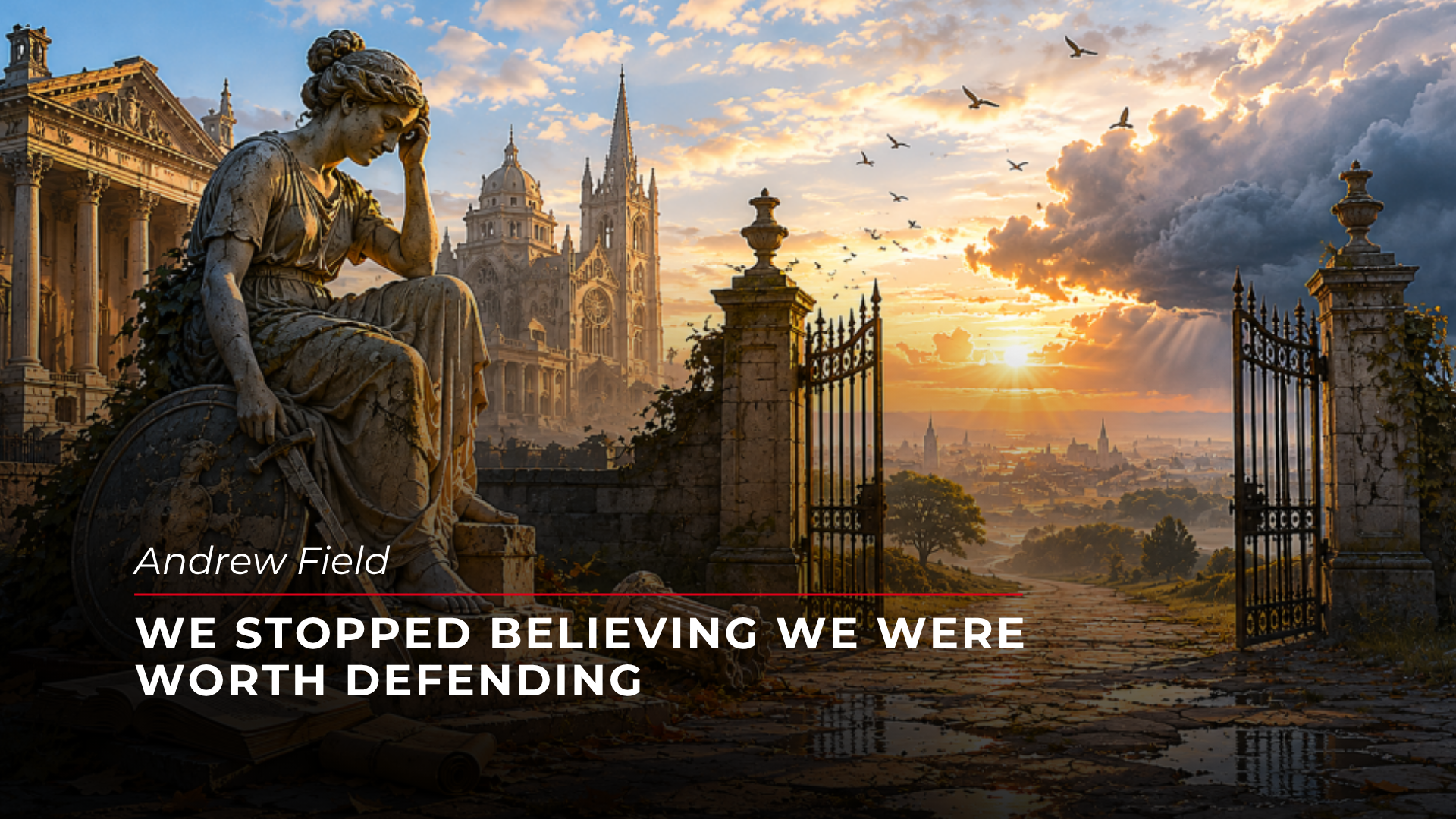
Now turn the lens on Europe, where the real puzzle lives. The mistake is to call what is happening an overthrow. Overthrow implies a strong invader seizing power against resistance. What is unfolding is closer to the reverse. A civilisation that no longer believes anything is struggling to hold a line against people who still do. The susceptibility is not Islam’s strength. It is Christianity’s absence. The cathedrals are tourist attractions. The bishops apologise for their own doctrine. A continent that cannot say with conviction what it believes cannot defend it against anyone who can. Douglas Murray mapped this hollowing in The Strange Death of Europe, and Michel Houellebecq turned it into a novel in which the elite surrenders to an Islamist party not because it is beaten but because it has nothing of its own left to fight with. The threat did not conquer the West. The West abandoned the field before the contest began.
The mechanisms are real and none of them needs a conspiracy. The first is structural. The secular state privatised religion three centuries ago and won that argument so completely that it forgot the argument existed, which leaves it unable to read a faith that refuses to stay private. The second is the creed of multicultural guilt, the horror of being called a bigot, which makes a magistrate hesitate over an imam where he would jail a vicar without a second thought. The third is the dullest and most decisive, electoral arithmetic. A community that votes as a bloc in a handful of marginal seats wields power out of all proportion to its size, while the diffuse majority never organises at all. Politicians do not buckle to theology. They buckle to the count.
Watch it happen in plain sight. Asked in the Commons last September whether she recognised sharia law and sharia courts, the Justice Secretary answered that sharia forms no part of the law of England and Wales, then added that submitting to such councils was part of religious tolerance and an important British value. No statute was changed. Something subtler was conceded. Roughly eighty-five sharia councils now operate across Britain, and the government’s own review of 2016 to 2018 found they routinely leave women worse off, trapped in unregistered marriages with no recourse to the courts. A minister of the Crown stood at the despatch box and rebranded a parallel jurisdiction that disadvantages women as a British value. The sharpest objections came not from the government but from Muslim women themselves. That is what surrender looks like when it wears a lanyard.
Here the irony sharpens. Europe did not become rational when it stopped believing. It became credulous in a new direction. A faith-shaped hole opened in the public soul, and something rushed in to fill it. That something is the progressive guilt-cult the age calls wokeness, and on the sharpest reading it is not the opposite of religion at all. It is religion stripped of grace and keeping only the inquisition. It has original sin rebranded as privilege, confession staged as the public apology, heresy hunts, excommunication, and a priesthood of the credentialed. Tom Holland argued in Dominion that the entire liberal moral package, human rights and equality and the compassion that powers all this, is smuggled Christianity in modern dress. The new cult kept the guilt and threw away the forgiveness.
So watch what a sated, post-religious society does with its last reserves of moral energy. It spends them policing pronouns and auditing the dead, while the one genuinely illiberal force on the horizon, the creed that really does jail apostates and stone women and murder cartoonists, is waved through under a doctrine that treats any scrutiny of a minority faith as a kind of violence. Call it the racism of low expectations, and Muslim liberals have named it louder than anyone, because they are the ones it abandons. The decadence is not merely the comfort and the surplus. It is the luxury of fighting imaginary battles because you have forgotten what a real one costs.
What, then, could stop it? Not a march back to church, because that would betray the whole argument. If the answer is simply choosing the least brutal cage, then freedom was never the point, only a preference in masters. The thing worth defending is not an altar. It is a set of freedoms any human being can hold, the right to blaspheme, to apostatise, to draw the cartoon, to leave. Somebody fought for those, and that somebody was the Enlightenment, now an old pensioner nobody visits.
You do not have to believe the tomb was empty to honour the soil those liberties grew in. Richard Dawkins, an atheist to his marrow, now calls himself a cultural Christian, preferring the society the church accidentally built to the one the muezzin proposes, while believing not a word of either. Keep the cathedral as a museum of where your freedoms came from. Do not mistake it for the freedoms themselves.
The call, in the end, is not for Christians to defend their patch. It is for the people who will suffer most under a harsher god to wake up before they do. The secularist, the atheist, the unveiled woman, the satirist, the apostate, every one of them treats his liberty as weather, as simply the way the world is. It is not weather. It was won, and it can be lost, and the believer who loses it merely changes which altar he kneels at, while the free man who never knelt has nowhere left to stand.
This is the part that should keep a thoughtful reader awake. A civilisation did not lose a war. It forgot why it won the last one. It emptied itself of conviction, invented a guilt-cult to fill the silence, and aimed that cult’s fury at its own guardians while opening the gate to a faith that would close every freedom the cult was built on. The Sahel shows what conviction without restraint can do. Europe shows what restraint without conviction comes to. So ask the only question that matters. Can a people who will not kneel and will not fight do anything in the end but kneel; hopefully, not under the sword?
Guest writer, Andrew Field, is the founder and author of the chronicle South of the African Equator and photoblog Simply Wild Photography
Discover more from Africa Unauthorised
Subscribe to get the latest posts sent to your email.

On fridays and sundays i wear my t shirt that says: religion kills.
Fridays i walk my dog past the mosque, always no one on my side of the pavement.
Sundays we walk past the church, must remember to take some pooh bags next time.
Excellent analysis, Ferod. Maybe your best to date>
A very, very well written summary of the threats of a dangerous religion and its political apologists. Will we wake up? Probably not!
Silly isn’t it when there is neither a god or an allah or a ……,,.