

By Andrew Field
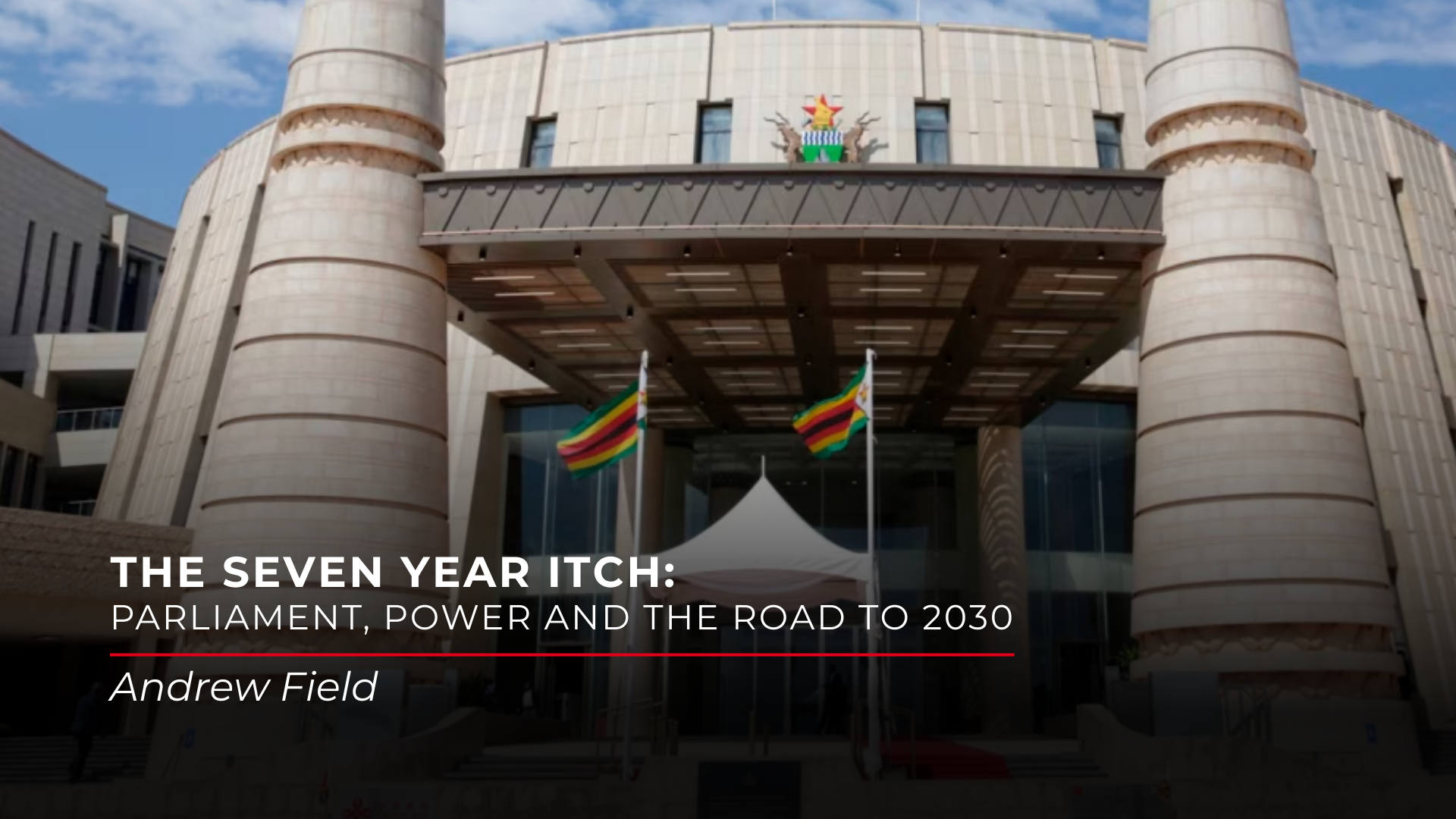
Zimbabwe is once again in the midst of constitutional surgery. Cabinet has approved a package of amendments that would alter the way executive power is acquired and exercised. Is this the anti-coup of the decade, or merely a precedent? The most consequential change is the proposal to repeal direct public election of the President and replace it with election by Parliament. At the same time, the presidential and parliamentary term would move from five years to seven.
Other amendments would adjust the role of the Defence Forces, alter aspects of judicial appointments, increase the number of senators appointed by the President, transfer delimitation to a new commission, and shift certain voter registration functions to the Registrar General. Taken together, this is the most significant reworking of the 2013 constitutional settlement to date.
The facts are not in dispute. If adopted, the President would no longer be chosen by a nationwide ballot. Members of Parliament would elect the President, under procedures overseen by the Chief Justice or a designated judge (hopefully not blessed with party patronage and large SUVs). The term of office would lengthen to seven years. The President would appoint ten additional senators.
The language describing the Defence Forces’ function would shift from an obligation to uphold the Constitution to a duty to act in accordance with it. The Zimbabwe Gender Commission would be absorbed into the Human Rights Commission. Public interviews for certain judicial appointments would be removed. Electoral delimitation would be separated from the partisan Zimbabwe Electoral Commission (ZEC) and placed in a new body. Voter registration responsibilities would move.
Each of these clauses can be defended in isolation. That is the Government’s position. Stability, policy continuity, administrative clarity and alignment with comparative models are the stated justifications. A parliamentary presidency exists elsewhere. South Africa elects its President through the National Assembly. Botswana’s President emerges from parliamentary majority leadership. Indirect election is not inherently undemocratic. It is a design choice.
Yet the reaction has been swift and visceral. Social media has filled with warnings of democratic regression. Unsurprisingly, the dominant narrative online is that this is a calculated move to extend President Mnangagwa’s tenure beyond the originally anticipated 2028 end date. The move to seven-year terms has been read not as institutional refinement but as personal extension. Hashtags resonate strongly with 2030. Critics describe Parliament as a rubber stamp. Civil society voices raise the spectre of constitutional manipulation dressed up as reform.
Legacy media has amplified that concern. Opposition figures and rights groups have spoken of vigilance and resistance. Some lawyers already argue that amendments of this magnitude need the peoples consent; a referendum. Others argue that Parliament actually has the authority to amend under the existing constitutional framework.
They might be reminded of Mugabe’s devastating loss in February 2000. The ruling party will never allow a repeat, by hook or by crook. The debate may have shifted from policy to legitimacy, but it’s truly academic now. Process matters. In constitutional politics, perception of legality is as important as text.
There is another strand to the reaction. The proposed change to the Defence Forces’ role has reopened the memory of November 2017. The military intervention that preceded the current presidency was subsequently validated by court orders. The language of section 212 has therefore acquired symbolic weight. Altering that language now invites interpretation. Is this a technical clarification? Or is it a deliberate closing of a jurisprudential door that once stood ajar? Either way, the shadow of 2017 lies across the page.
Judicial appointments have also come into focus. Removing public interviews is viewed by critics as a step away from transparency and as entrenching capture. Expanding presidential appointment power in the Senate is read as a consolidation. Shifting electoral functions raises concerns about independence. Abolishing a standalone commission is seen by some as a dilution of oversight. Individually, these moves can be explained. Collectively, they form a pattern in the public imagination. Power appears to be concentrating, not dispersing.
And yet, once the temperature drops, the structural logic demands attention. A parliamentary presidency does not extinguish electoral politics or erode democracy. It relocates its centre. Instead of a direct presidential race determining executive leadership, parliamentary elections become decisive. The majority in the House selects the President. That is the simple arithmetic.
Under the current system, an opposition might theoretically lose Parliament yet win the presidency through a national vote. Not presently likely! That may be a big threat, although difficult to understand why. Zimbabwe’s opposition has been divided and pathetic. Under a parliamentary presidency that path closes, seemingly overkill in reality. Executive authority flows through the legislative majority. The battlefield narrows to one arena. Parliament becomes everything.
This leads to an uncomfortable but inescapable conclusion. If the opposition cannot consolidate and secure a parliamentary majority, the reform is largely academic. Whether the President is directly elected or chosen by Members of Parliament, executive power will continue to reflect the dominant party’s strength. The decisive variable is not the mechanism but the numbers.
That does not make the reform irrelevant. It makes it conditional. If an opposition were to win Parliament under the new dispensation, it would, in principle, have the power to elect its own President. That is the core logic of parliamentary systems. Executive survival depends on legislative confidence. Lose the House, and you lose the office.
But transitional mechanics matter. If an incumbent President elected under the previous system remains in office while a newly elected Parliament sits, friction may arise. The President retains substantial powers. He appoints ministers. He assents to legislation. He commands the Defence Forces. He influences senior appointments. He may refer Bills back to Parliament. The scope and override thresholds of these powers become crucial.
If a President can delay legislation and override requires a supermajority, a simple parliamentary majority may struggle to govern effectively. If dissolution powers remain broad, instability could follow. If appointment authority is concentrated, administrative resistance may blunt legislative intent. These are not speculative anxieties. They are structural features that must align with the source of executive legitimacy.
In mature parliamentary systems, removal mechanisms are clear and attainable. A government that loses majority support falls. The United Kingdom operates through collective Cabinet responsibility. South Africa allows the National Assembly to remove a President. Botswana’s model reflects majority leadership. Ethiopia’s Prime Minister derives authority directly from Parliament. In each case, executive authority is tied to legislative confidence.
Zimbabwe’s proposed reform retains a strong presidency. It modifies the route to office without clearly diluting executive capacity. That hybrid quality will determine its success or strain. If executive powers are not harmonised with parliamentary supremacy, a divided system could produce deadlock. If they are harmonised, the model could function coherently.
There remains the question of motive. Extending terms from five to seven years inevitably alters timelines. If transitional provisions result in President Mnangagwa remaining in office two years longer than initially anticipated, this will be read as unprecedented in Zimbabwe’s constitutional history. Presidents have sought to remain in office before. But altering the length of a current term through amendment, rather than through election, carries symbolic weight.
Is it unprecedented on the continent. No. African constitutional history contains examples of term extensions, resets and reinterpretations. But each case carries its own context. In Zimbabwe, where the 2013 Constitution was adopted after prolonged national negotiation and referendum, any substantial amendment invites comparison with that foundational moment. The scale of change matters.
he charge that these reforms aim to secure an additional two years cannot be dismissed outright. It is a plausible reading of political timing. Yet politics has always been about moments. The deeper question is whether the system that emerges after that extension will allow genuine alternation in power.
Democracy is not a slogan. It is a mechanism. It is the ability of citizens to replace leaders through lawful means. If parliamentary elections remain competitive, if opposition parties organise freely, if courts retain independence, and if removal mechanisms function, then a parliamentary presidency need not erode democratic substance. It will simply change the route by which authority is conferred.
If, however, parliamentary elections are structurally skewed, if party discipline renders Members mere extensions of executive will, if oversight institutions weaken, then indirect presidential election becomes an internal party selection process. In that environment the reform entrenches rather than balances.
The outrage on social media platform X reflects distrust. The legal debate reflects concern for process. The security discussion reflects memory. The arithmetic points to Parliament. Each strand is real. Each speaks to a different anxiety.
And so we return to the uncomfortable truth. Without a parliamentary majority, opposition rhetoric is mere theatre, like the choreography unfolding over Epstein. With a parliamentary majority, the reform could facilitate the transfer of executive power. Everything turns on numbers; and the people’s will..
Two years matter. Power matters. Precedent matters. But ultimately, the decisive question is whether Zimbabwe’s political opposition can marshal sufficient support to control the House and break the ruling party’s 46-year hegemony. If they cannot, constitutional design is actually secondary. If they can, constitutional design will shape the transition.
This is not an argument for complacency. It is an argument for clarity. The reform may well be driven by the desire to extend a presidency. It may also be framed in the language of stability and comparative practice. Both can be true. The constitution is being recalibrated. The motives are debated. The reactions are intense.
Ultimately, the amendment shifts the centre of gravity to Parliament. But with a divided and weak opposition, the ruling party’s dominance remains unchallenged. Whether the President is elected directly or indirectly, executive power will continue to reflect the same majority. Until the opposition consolidates, constitutional design is secondary; an academic exercise against the reality of a well-entrenched hegemony.
Guest writer, Andrew Field, is the founder and author of the chronicle South of the African Equator
Discover more from Africa Unauthorised
Subscribe to get the latest posts sent to your email.

ALL of what you have set out above is nothing more than an elaborate smoke screen to ensure that ZANU-PF and any Thug leading it, stay in control of the Sinking Ship “S.S. Zimbabwe”, forever.
There is NO Difference in what they are currently proposing from exactly how the U.S. Democrats, the Canadian Liberals, or the British Labour, Parties, currently function.
When OH When, will Zimbabwe ever be spared from these pathetic excuses, for “REAL” National Leadership ???
Doug, you do misjudge me once more. I understand the frustration in your comment. Many Zimbabweans feel worn down by what appears to be endless manoeuvring at the top while the economy drifts and ordinary citizens carry the burden. They are equally frustrated with no emergence of a tangible, strong opposition. That anger is real. It deserves acknowledgement.
But the article was not written as a defence of the amendments. It was written as an analysis of how they function and that until there is a decent opposition capable of takening power the who exercise is academic.
I stated clearly that extending presidential and parliamentary terms from five to seven years, especially in this political moment, inevitably raises the question of tenure extension and the road to 2030. That concern is legitimate. It would be naïve to pretend otherwise. If transitional provisions result in President Mnangagwa remaining in office beyond the originally anticipated timeline, that will be read as a deliberate extension. That point was not hidden.
However, the core argument remains structural.
Whether the President is elected directly by voters or indirectly by Parliament, executive authority ultimately depends on parliamentary arithmetic. If ZANU PF holds a majority in Parliament, it controls the executive under either system. If an opposition consolidates and wins a parliamentary majority, it controls the executive under either system. The mechanism changes. The numbers decide.
That is the uncomfortable part of the analysis.
You also suggest this is simply an illegitimate route dressed up as reform. It is worth noting that this debate has now moved beyond commentary. David Coltart and other lawyers have publicly argued that the proposed route is unconstitutional and will be contested in court. A group of liberation war veterans has already filed an application in the Constitutional Court challenging the legality of extending terms and altering the method of presidential election without a referendum. That legal process is now underway.
In other words, the legitimacy question is not theoretical. It is before the courts.
Whether the Constitutional Court agrees with those challengers is another matter. But the fact that formal litigation has begun shows that this is not just social media outrage. There is a legal front as well as a political one.
That said, even if the amendments were struck down and a referendum required, the deeper structural point does not disappear. Referenda are political contests. Parliamentary elections are political contests. Court cases are political contests in legal form. Ultimately, power in Zimbabwe is determined by organised support and institutional control.
You compare this to other Western parties and conclude there is no difference. There is in fact a significant difference. In established parliamentary systems, executive authority flows from legislative majority within a context of competitive elections, strong courts and independent institutions. The mechanism itself is not the issue. The surrounding ecosystem is.
My article did not argue that everything is fine. It argued that constitutional engineering alone does not secure permanent control. Parliamentary dominance does. If ZANU PF retains control of Parliament, it will control the presidency whether the system is direct or indirect. If the opposition cannot consolidate and secure a majority, no constitutional design will deliver change on its behalf.
That is not endorsement. It is realism.
Anger may be justified. But arithmetic decides outcomes. If citizens want a different result, the decisive battleground remains the House. Courts may intervene. Referenda may be debated. Amendments may be challenged. Yet without parliamentary numbers, the rest remains argument.
The point of the article was not to minimise the stakes. It was to identify where the real contest lies.
Aah, no matter what laws or rules of governance there are, in Zimbabwe they will be broken by the government or the leaders of government.
No hope.
ALAN: Exactly SO, they know nothing else since April 1980…