

By Andrew Field
Ronald Lamola, South Africa’s Minister of International Relations and Cooperation, stood before the cameras in Pretoria and told the continent that South Africa cannot be a remedy for Africa’s immigration crisis. His department had just welcomed the African Union Council’s rejection of Ghana’s proposal to place South African xenophobia on the agenda. In its place he offered a continent‑wide summit on migration. Five percent of Africans live outside their country of birth, he said, and not by choice. While he spoke, the buses were still running north to the Limpopo.
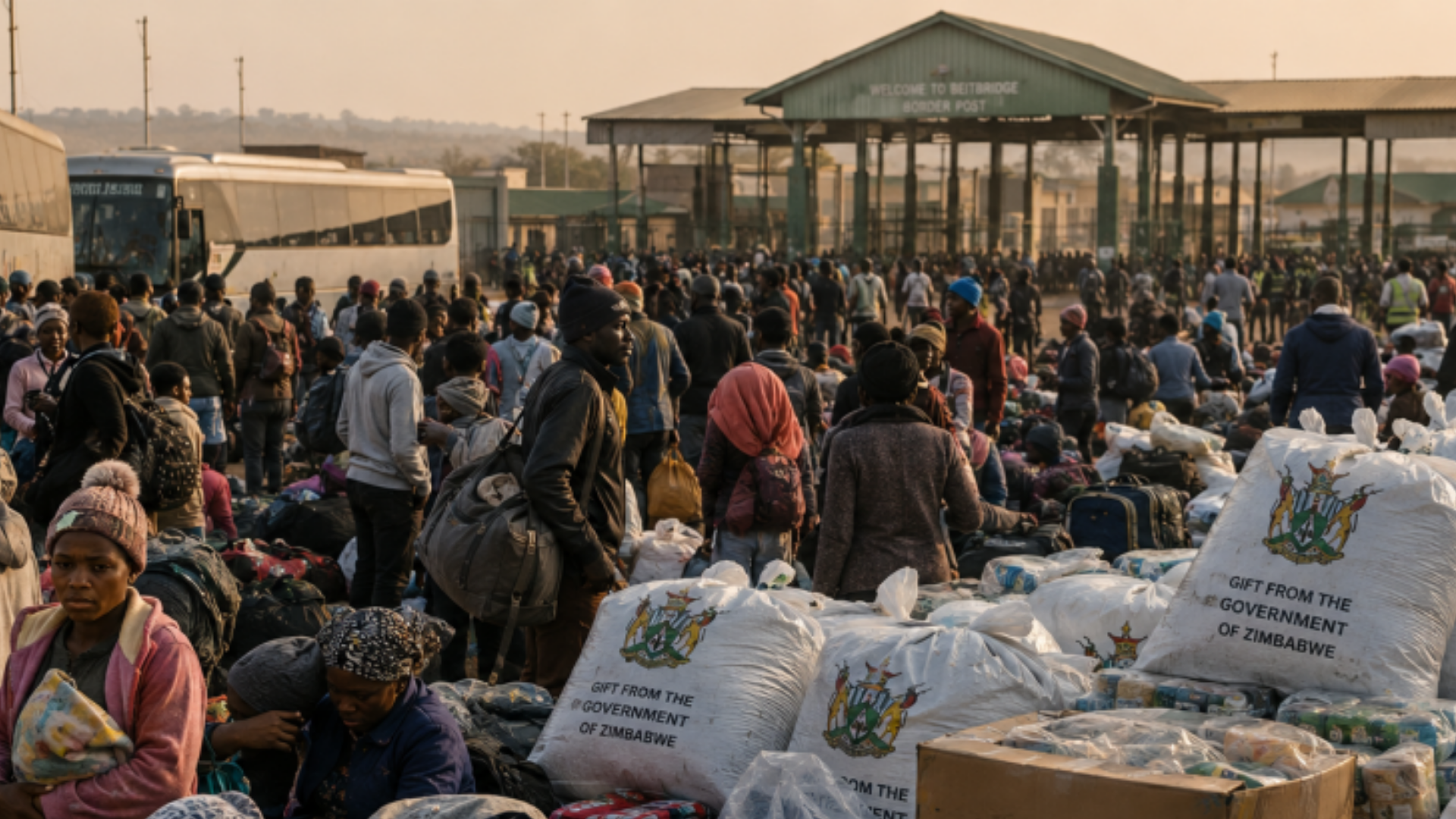
The chief director of immigration in Harare, Respect Gono, puts the count at 72,658 Zimbabweans repatriated through Beitbridge, with a further 72,272 Malawians passing through Zimbabwe on their way home. More than 140,000 people through a single border post. Cabinet’s own figure was 99,418 Zimbabwean citizens returned between 28 May and 10 July, more than 70 percent of them women and children. South African immigration officers process them biometrically, with a fervour not often seen at Musina, declare them undesirable, and issue five‑year bans on re‑entry. The paperwork is immaculate.
This is the largest forced movement of people in southern Africa since the Mozambican civil war, and the continental body charged with African affairs has decided it is not a matter for discussion. The word being reached for is racism, and it is the wrong word. There is no racial line to police here. The victims are Zimbabwean, Malawian, Mozambican, Somali, Nigerian and Bangladeshi. The perpetrators are South African. What is being hunted is nationality, accent, documentation and the wrong vowel in a clinic queue. Some analysts prefer afrophobia, and the precision matters, because a charge laid wrongly is a charge easily beaten, and the real offence then walks out behind the acquittal.
The offence itself has been assembled in plain sight. In January crowds gathered outside Addington Primary School in Durban, claiming South African children were being displaced by the children of foreigners. The provincial education department noted that 63 percent of the pupils were South African. Police used stun grenades and water cannon. In April a street‑cleaning campaign in the Durban CBD turned into the apprehension of suspected foreigners and their delivery to police stations.
In late May there were deaths at Mossel Bay and hundreds displaced. On 7 June the President addressed the nation, condemned vigilantism and announced enforcement measures. The vigilantes responded by setting 30 June as the date by which undocumented foreigners were to be gone. The deadline had no statutory force, no gazette, no court behind it. It was honoured anyway. About 120 marches were held on the day and more than 900 people arrested, and by then the exodus was already weeks old. What followed was the state arriving with buses and biometric scanners to give administrative shape to a private ultimatum.
That is the charge against Pretoria, and it is heavier than the one usually laid. The accusation of doing nothing would be easier to answer. Doing nothing for twenty years is what built the pressure, certainly, through a Home Affairs department so corrupt and incompetent that legality became a lottery and the queue at Marabastad a market. Successive extensions of the Zimbabwean Exemption Permit taught two million people that status in South Africa was a matter of political weather rather than law. Distrust of African immigrants climbed from 62.6 percent in 2021 to 73.1 percent last year. A government that will not enforce its own statutes eventually finds that somebody else will.
But what happened after 30 June was not inaction. It was ratification. The removals proceeded, the bans were stamped, the trucks rolled to Musina, and at no point did the state have to own the decision, because the decision had been taken on a Durban street corner by a former radio presenter. Pretoria has achieved the outcome its politics could not vote for and its courts would not permit. It gets deportation without a deportation policy, and it gets to tell Ghana that it is being scapegoated. There is a word in the criminal law for a man who arranges for others to do what he may not do himself, and it is not bystander.
Harare’s conduct deserves no gentler treatment. The reception at Beitbridge has been staged with care. The First Lady toured the centre on 7 July and donated 30 tonnes of rice, 20 tonnes of mealie meal, more than 5,000 tracksuits, 1,500 packets of nappies and sanitary wear. An inter‑ministerial committee was formed. The Registrar General deployed officers to issue replacement identity documents. The President appealed to Zimbabweans to receive the returnees with the true African values of compassion, love and caring for one another. The ruling party’s spokesman announced that the economy could absorb them.
Every element of that is compassion performed at the point of arrival, and none of it addresses the question of departure. There are no reliable figures for the Zimbabwean population in South Africa, and estimates run past three million. Those people did not leave because South Africa was inviting. They left because the currency was destroyed four times; because the farms were seized without compensation or competence; because Murambatsvina bulldozed the urban poor into the veld; because Gukurahundi taught Matabeleland what the state was for; and because a graduate in Harare could not buy a bag of maize meal with a month’s salary. The exodus was not a misfortune that befell Zimbabwe. It was policy, sustained across four decades, and its function was to export the unemployed and import their remittances.
Those remittances are the point. They have propped up the fiscus, cushioned the collapse and paid the school fees that the state stopped funding. A million people abroad sending money home is a welfare system that costs the treasury nothing and generates no political demands. Now a portion of that system is being returned to sender, arriving at Beitbridge with a plastic bag and a five‑year ban, and the government that engineered their departure meets them with tracksuits and a homily about African values. Compassion is cheap when the cause of the suffering is standing at the podium delivering it.
Then there is the continental architecture, which has arrived at the only position available to it. The African Union cannot find language for a Black African state expelling Black Africans, because the entire vocabulary of the institution was built for a different offence, committed by different people, in a different century. Confronted with a member state running removals at scale, it declines the agenda item and proposes a conference. The 46th SADC Summit convenes in Durban on 17 August, hosted by the country in question, with the theme of resilient and inclusive industrialisation, and migration not tabled for discussion. Zimbabwe and Malawi will sit in that room and say nothing, because their governments have already accepted the buses and issued the press releases and would rather not be asked what they intend to do with the people inside them.
The European comparison is instructive, though not in the direction it is usually pointed. The instinct is not absent there. Ballymena burned in June last year, Torre Pacheco a month later, and Southport before both. Denmark has run the hardest asylum regime in Western Europe for a decade under a social democratic government; Germany deports to Afghanistan; Britain designed an offshore removals scheme and had it struck down by its own judges. The appetite is identical. The difference is the position of the state. In Europe the government is the brake and the courts a harder one, which is precisely why the frustration keeps venting into the street. In South Africa the brake failed in the opposite direction and the state fell in behind the crowd.
Yet Copenhagen tightens family reunification and is denounced across the European press as far right, while 140,000 people pass through one African border post in ten weeks and the African Union rejects the agenda item. Part of that gap is honest description, since the European case carries a visible racial line and the South African one does not. Most of it is not description at all. It is that the institutions of the continent have spent sixty years building a moral framework in which African governments are the injured party, and they have no instrument that reads in the other direction.
So the buses run, the bans are stamped, the summit convenes in Durban under the banner of inclusive industrialisation, and the returnees are counted in tonnes of mealie meal. Who exactly is being scapegoated here?
Check out Andrew’s blog here – https://justandrewinzimbabwe.wordpress.com
Discover more from Africa Unauthorised
Subscribe to get the latest posts sent to your email.

Maybe if More Effort, was put into these African states actually running their countries like a well functioning machine, instead of the current Willy-Nilly, cockeyed policies, so favoured by so many, This Emigrant problem would not be a great as it currently is ..
To say the Clowns are running the Circus, or that the Momparas are in charge, would be putting it all in a mild sentence..
This article should be on the front page of every major news outlet – European and African. The truth so commonly ignored !!