

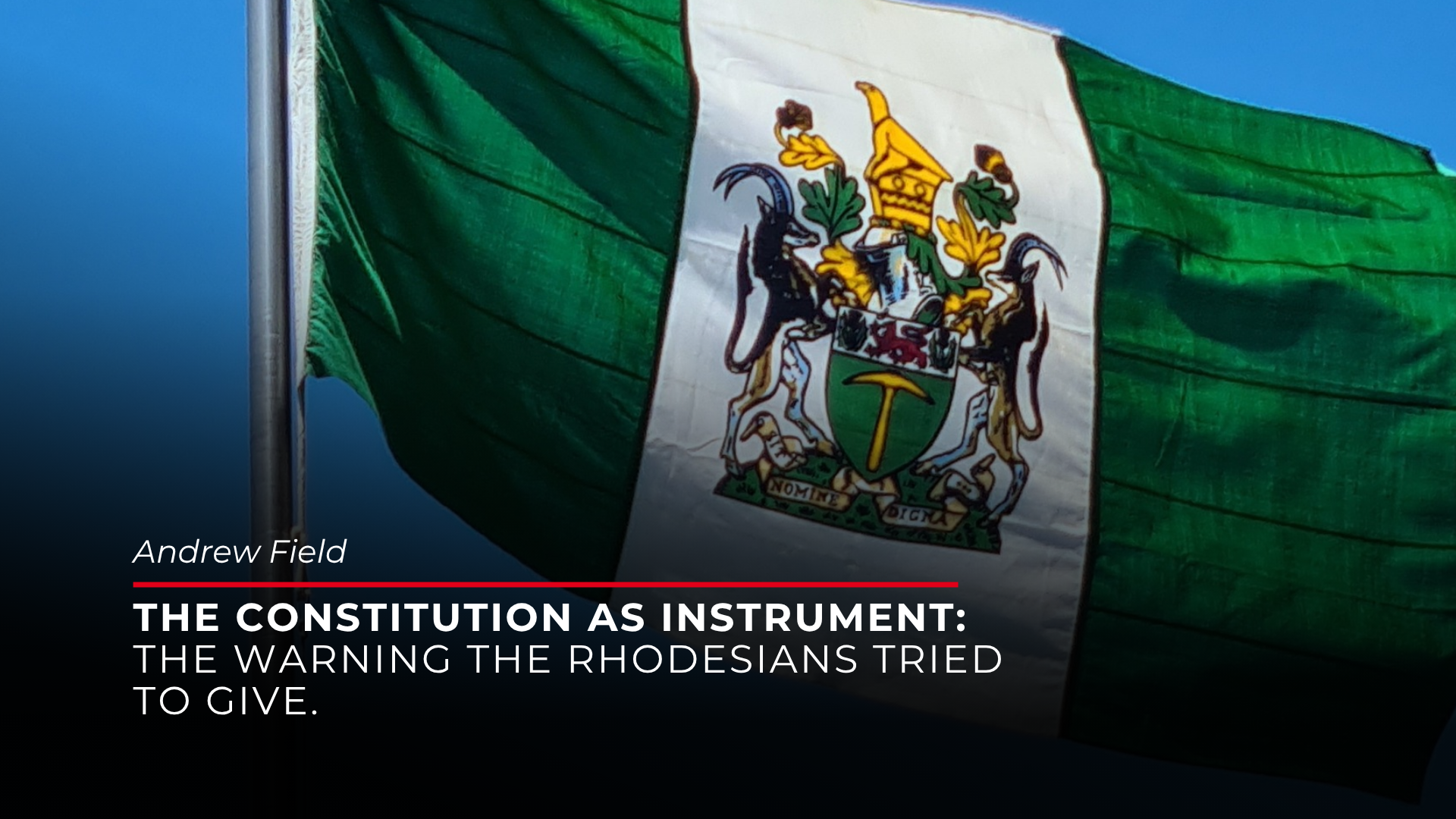
Andrew Field | South of the African Equator | April 2026
Bertrand Russell, writing with characteristic precision about the dangers of Marxist political philosophy, once identified what he considered its most corrosive feature. It was not just the economics. It was the morality and ethics of Marxism. Russell opined that this political curse grants the revolutionary a moral exemption that never expires.
The oppressed are entitled to commit wrongdoing and bloody violence against the oppressor. Violence is not merely permissible; it is actually sanctified by historical necessity. The ends justify the means, and once that principle is established, it does not dissolve when the revolution succeeds. It waits, cunningly, for the next opportunity to arise. And so it has in Zimbabwe.
Zimbabwe was born of exactly that logic. The liberation struggle of the 1970s was prosecuted under a Marxist-Leninist moral architecture in which the Rhodesian state was the oppressor. The insurgent cadre was the vanguard of history, and the means. Asymmetric warfare, the civilian intimidation, the cross-border raids, the terror were each sanctified by the cause.
That framing was not merely propaganda. It was genuinely believed; revolutionary gospel more powerful than God. It carried the full weight of a moral system that subordinated individual ethical constraint to collective revolutionary purpose. The “struggle” was born, if not manifested, in the bowels of communist agitation of the 1960s. Zimbabwe African National Union (ZANU) was forged in that conviction, and it has never entirely left it.
Fifty years on, something has changed. Not the party’s grip on power. That endures with the solidity of weapons-grade titanium. What has changed is the direction in which the moral exemption points. The very people in whose name the liberation struggle was prosecuted; the peasants and the working class are now, perceivably, the oppressed. Normal people, the rural communities, and those dispossessed of wealth or opportunity are now the victims of a cause that would have been cited in 1976 as moral justification for armed resistance.
Let us not escape from the fact that a large proportion of Zimbabwe’s population lives in poverty, while the political elite boast of their gluttony. The cause that the ‘struggle’ was said to have purchased is being rewritten behind closed doors. And the very party that once claimed their cause against the oppressors, now constitutes precisely the oppressive ruling class that Russell warned against. The victorious revolutionary vanguard inevitably becomes the oppressor. The exemption has transferred to the new oppressor. Quietly, without announcement, and without shame.
Now to the crux of it. Constitutional Amendment Bill No. 3 — CAB3, as it has become known, is the most visible expression of that transfer to date. Gazetted on 16 February 2026, the bill proposes a comprehensive reworking of the 2013 constitutional settlement.
Presidential and parliamentary terms would extend from five years to seven. The citizen’s direct vote for president would be abolished, replaced by election through a joint sitting of Parliament. The Senate would be enlarged by ten seats, all presidentially appointed. Voter registration and the maintenance of the voters’ roll would return to the Registrar-General (an office with a long and documented association with partisan administration).
A new delimitation body would be created, appointed by the same president whose electoral fortunes it would shape. The Zimbabwe Gender Commission and the National Peace and Reconciliation Commission (NPRC) would be abolished. Transparency in judicial appointments would be reduced. Each clause, the government insists, is a technical refinement in the service of stability. But this is merely a façade for the deeper objective.
The legal argument deployed to push CAB3 through Parliament rather than a national referendum is a masterclass in selective reading. Section 328 of the 2013 Constitution requires a referendum only for amendments touching Chapter 4 (the Declaration of Rights), Chapter 16 (Agricultural Land), or Section 328 itself. The Attorney General, Virginia Mabhiza, argues that CAB3 touches none of these. Therefore, she maintains, a two-thirds parliamentary majority is legally sufficient. What she cannot address is that subsection (7), states plainly that amendments extending time in public office may not apply to someone already holding that office. President Emmerson Mnangagwa‘s effective term, extended from 2028 to 2030, is an incumbent benefit. This requires overriding Section 328(7), an amendment of Section 328; and that requires a referendum. The Attorney General is not confused about this. She is counting on the public being so.
The mockery of the people through a choreographed public consultation process has been conducted with contempt that is difficult to overstate. Parliament compressed hearings across a handful of venues in four days. Thousands of citizens in a country of 15 million people could not attend in person. Those who did found venues packed with bused-in ZANU-PF supporters, seated at the front, pre-selected to speak, performing endorsement on cue. Even the most dull observer could see this.
Bulawayo’s Mayor David Coltart sat at the front of his hearing, raising his hand repeatedly. He was ignored throughout. Former Finance Minister Tendai Biti was arrested in Mutare while mobilising citizens against the bill. At the City Sports Centre in Harare, human rights lawyer Doug Coltart was surrounded and struck by a partisan crowd. His glasses were broken. His phone was taken from his hands. ZANU-PF Treasurer Patrick Chinamasa subsequently offered behavioural science as an explanation for why crowds of unified political conviction react violently to dissent. He appeared not to notice what he had admitted.
War veterans, those who once claimed the revolutionary moral exemption, have gone to the Constitutional Court. Retired generals have formally written to Parliament, demanding a referendum. The Zimbabwe Human Rights Commission has warned that CAB3 risks undermining the democratic foundations it claims to refine. Retired Air Marshal Henry Muchena, a liberation war veteran and die-hard ZANU-PF member of fifty years, has publicly aligned with the opposition to the bill. These are not the voices of enemies of the state. They are the voices of the state’s own founding generation, looking at what the party has become and finding it unrecognisable. Perhaps they realise, and they should, how revolutionary licence can transfer.
And what of the political opposition? It is weak, disjointed, and chronically divided. It has failed, consistently and comprehensively, to penetrate the rural areas where ZANU-PF’s real power is rooted and where elections are ultimately decided. Morgan Tsvangirai was the last opposition leader capable of crossing the urban-rural divide with genuine mass appeal. He was a trade unionist. He spoke in the language of ordinary people. Even he could not break ZANU-PF’s structural hold on the rural constituency; a hold maintained through patronage, intimidation, and the enduring emotional power of the liberation narrative in the communal lands.
Since his death in 2018, the opposition has fragmented into educated urban voices, personality conflicts, and factional warfare. At best, it is an urban social media phenomenon with no credible presence where the votes are. The Citizens Coalition for Change collapsed into internal recrimination. The Movement for Democratic Change has split so many times its identity has become almost meaningless. There is no organised rural network. There is no coherent ideological alternative to the liberation myth. There is no credible parliamentary path to power. And this is why the people can be bullied into illegal ‘reforms’.
This matters because CAB3, if passed, makes Parliament everything. The president would be elected by Members of Parliament rather than by popular vote. Win Parliament and you choose the president. Lose Parliament and executive power is beyond reach. That is not unique.
Under the current system, an energised opposition might theoretically win the presidency through a national vote while losing Parliament; unlikely, given ZANU-PF’s structural dominance, but constitutionally possible. Under CAB3, that path closes permanently. The battlefield narrows to one arena. And in that arena, ZANU-PF has held a supermajority for years, sustained by delimitation it controls, a voters’ roll it is reclaiming, and rural communities it has systematically insulated from opposition penetration.
Without a functioning opposition capable of mounting a credible electoral challenge, the ballot cannot deliver change. The courts are structurally compromised by decades of eroded transparency in appointments and executive patronage. The referendum, the constitutionally correct instrument, is being engineered out of reach by a creative reading of Section 328(6) that discards everything that follows it.
What remains, as Russell’s cycle completes its rotation, is the street or the barracks. Neither is reliable. Zimbabwe’s military demonstrated in November 2017 that it is capable of intervention when internal factional stakes are sufficiently high. The deepening rift between Mnangagwa and Vice President Constantine Chiwenga, the general who placed Mnangagwa in power, and the recent pre-emptive replacement of senior military figures loyal to the 2017 operation, can only suggest that those stakes are rising again.
A coup mounted, heaven forbid, to restore democracy would face the immediate question of whose democracy and whose coup. It might temporarily stabilise the state, as it did with the dispatch of Robert Mugabe. It would not resolve the pathology. Popular uprising carries the same verdict. A new vanguard claims the same exemption. The cycle Russell identified turns once more. The Rhodesians feared this would be the case, drawing on the experiences of the north.
The deepest irony in Zimbabwe’s current predicament is this. The moral logic that ZANU-PF used to justify its insurgency against the Rhodesian state (that the oppressed are entitled to resist by any means necessary) is now available, by exactly that logic, to the people ZANU-PF has itself oppressed. The party cannot coherently condemn resistance without condemning its own founding.
What a mess. The moment the party invokes constitutional order to suppress dissent, it speaks with the voice of the regime it once fought. The moment the people invoke liberation principles to justify opposition, they use the party’s own vocabulary against it. ZANU-PF planted that seed across generations. The party should not be surprised to find it germinating in different soil under different conditions. The majongwa are coming home to roost.
The question facing Zimbabwe is not whether Mnangagwa serves until 2028 or 2030. Seriously, two years are not the point. The real question, the one CAB3 forces into the open, is whether Zimbabwe’s constitution is still a restraint on power or the drafting instrument through which power rearranges itself. A constitution that can be manipulated by the very people it was designed to constrain is not a constitution. It is a ceremony. It is the scaffolding of legitimacy erected around decisions already taken in rooms the public cannot enter.
The people of Zimbabwe need to wake up to that reality. Not in the morning. Now. Sadly, one might opine, it is too late. To use the old cliché, the horse bolted a couple of decades ago. The people have lost control to an entrenched political elite. The social contract written in 2013; negotiated painstakingly, adopted by referendum, presented as the document that would prevent another Mugabe; is being dismantled clause by clause, hearing by hearing, legal opinion by legal opinion.
The voices raised against it have been physically struck down. The institutions designed to protect it are being hollowed from within. The opposition that should contest it is too fractured to mount a coherent challenge. And the governing party that is doing all of this was built on the principle that the oppressed are entitled to resist their oppressors. And the party knows it. Tragically, the elixir for Zimbabwe’s woes has become a toxic mix of its own making.
Guest writer, Andrew Field, is the founder and author of the chronicle South of the African Equator and photoblog Simply Wild Photography
Discover more from Africa Unauthorised
Subscribe to get the latest posts sent to your email.

The facts were faced 46 years ago. All we can say, and we do, is “I told you so”. There is truth in most of what you raise, but it is now water under the bridge. It offers no comfort to the victims of history living in or outside Zimbabwe today. Whatever foreign powers did or failed to do, the country’s present misery is being sustained by its own rulers in real time. History explains much; it fixes nothing. What will people think of Europe in 50 years’ time? Probably the same as you do of Rhodesia’s demise… Nothing is going to change, but there is delight that it’s coming full circle!
Face the facts – the place is buggered and the world keeps turning a blind eye. Screwed by the only time the Yanks and the Poms have sided with the Communists Russians and China since WWII. Propaganda and global “public opinion” especially in the west put the nails in the coffin, along with Portugal collapsing, and then the world due to pressure from the big four above (at the time as Britain is now a wet, weak, woke and wanky shadow of what it once was, unrecognisable to many of us) put sanctions on Rhodesia. The communists knew exactly what their end game was – undermining capitalism, and access to mineral and agricultural wealth with their eyes firmly fixed on South Africa for its strategic geographic location and mineral wealth. The west was just weak and stupid.
And now none of them care about the awful reality they have created.
Vale Rhodesia and now Vale Zimbabwe.