

Hannes Wessels,
A few weeks ago, a friend and former soldier of distinction presently writing a book relating to the Rhodesian civil war asked me for my thoughts on why young Rhodesians performed so exceptionally well as soldiers, airmen and policemen at so young an age.
In the course of the discussion, we noted the fact that less than six months out of school it was not unusual for boys in their teens to be deployed into hostile territory in small four-man ‘call-signs’ (sections) for five to ten days with little more than maps, a radio, a compass, codes, flares, grenades, ammunition, personal weapons, food and water.
My friend, now living in the UK pointed out it would be very difficult to find young men there, or Europe, or in the US, who would be capable of rising to this sort of challenge, Indeed current research indicates that most young people in the UK would not fight for the defence of their nation, which they have relentlessly been taught in primary, secondary and further education to disrespect for its shameful colonialist history and inherent racism. He went on to explain that this sort of task, in most modern armies, is reserved for experienced special forces soldiers, and then invariably with significant fire support available as a quick response.
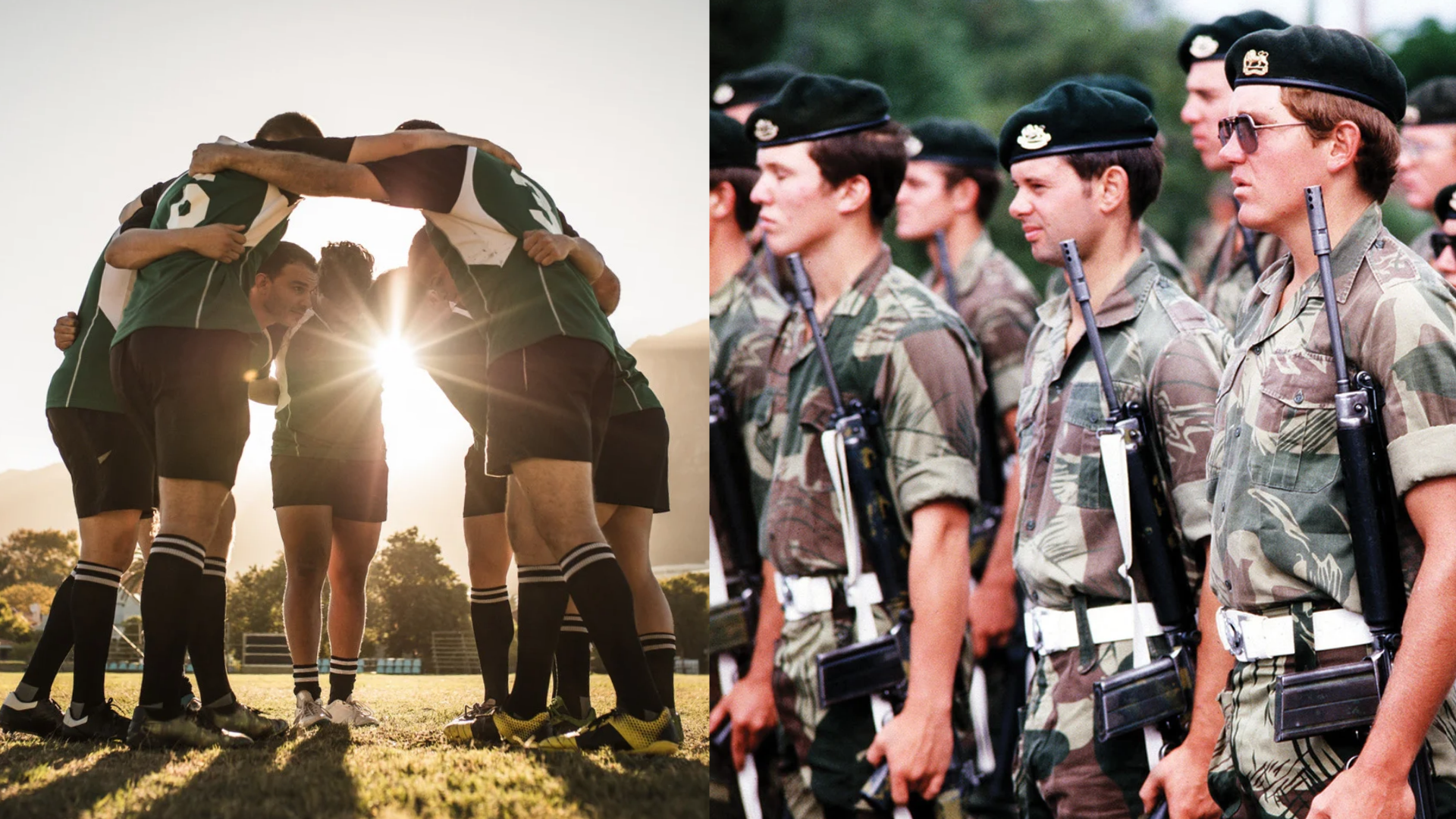
In trying to answer his question I have struggled a little for answers, but I do think sport, particularly team-sports, and rugby especially played an important role in preparing these young men.
A key component in the school-system of the day, unlike the modern world, was the making of team-sport compulsory. This process fostered teamwork and pride in one’s team and school, and ultimately country; it facilitated physical development, a sense of loyalty and commitment to team-mates, camaraderie, an ability to endure physical hardship and often pain without unnecessary complaint, while also teaching players how to lose without shame and how to triumph graciously. The sports-field was the perfect place for those born to lead to grasp the nettle and to stake their claims. All this against a backdrop of discipline, a strict uniform dress-code, insistence on personal hygiene, and a culture that demanded respect for seniors seems to have succeeded in producing young men (and women) who were prepared for a life of adversity that would test them physically and mentally, which enabled them to accept without undue alarm that daily hardship and discomfort was inevitable, and early death a distinct possibility. These sorts of people provide mental and physical muscle to strengthen a community and a country.
At the time, more than 50 years ago in my case, for us in the system this process appeared to be absolutely normal, it is only now with the passage of time and hindsight that we realise we were more the exception than the rule and that in today’s world virtually no such regimen exists, so it is not surprising that the youth of today would struggle to perform in the way we were expected to do. It is perfectly understandable to argue that school-leavers of the modern world are taught different skills and codes of behaviour better suited to the demands of the day and this may well be true but I would still argue any nation will be strengthened by insisting, or at least encouraging, all its children and teenagers to learn some of the important lessons of life on the field of sports.
Which leads me to digress and focus on South Africa today where a powerful rugby team with a white coach and a black captain is showing an inherently fractious country the way to dispense with the racism that threatens to destroy it and replace it with a shared sense of destiny based on merit and mutual respect. This beacon of light would not have shone were it not for the fact that the country, through the schools, has imbued its children of all races with a love of sport and more specifically, a love of rugby.
History we hope, will record the fact that Rassie Erasmus and Siya Kolisi, along with the players that wear the Springbok jersey may have led the people of the South Africa they love away from catastrophic conflict by using the sports field as a showcase for how people from a variety of racial and ethnic groups and social and economic backgrounds can quickly coalesce around a shared goal and prevail in spite of all the innate differences that so easily divide them.
Now in my twilight years, and looking at what appears to be the collapse of what was loosely known as ‘western civilisation’ I can identify a litany of reasons for this lamentable development but I have little doubt that this would not have happened had the children of those countries been processed through the same system of schooling in which I was fortunate enough to have been educated in the classroom and sports field.
Discover more from Africa Unauthorised
Subscribe to get the latest posts sent to your email.

Bang on once again Hannes
Hannes,so very true and thank you for a great read.
Hannes, you have summed up this entire situation to perfection. I grew up in the public school system, of Toronto, Canada, in the 1950’s and early 1960’s and the only binding factor was always “My school against Your school”, but not basically in a sporting sense. Today people aiming to get into a military set up in places like Canada, do this to learn a trade or skill that will assist them when they are non-military once more, and someties if they cannot crack the job market occurring at that time. The thought of actually having to give up my life, for the place I live in, is really abhorent to the vast majority of those voluntarily entering the Services.
That Espirit de Corps, that you know existed in Rhodesian schools and still somewhat in South African places today, is something of a bygone era. and certainly does not fit into modern day living, in most of North America, the U.K. and many parts of Europe.at this time.
Our World is much poorer for this Loss, as it called all citizens together, when the challenges had to be met, head on..
Hannes the fact that we were trained in discipline and the fundementals of soldiering by being subjected at a young age in school cadets. By the time I went to Heany barracks for National Service training, the concept of soldiering was nothing new.
You nailed it Hannes. Sport is a great equaliser and then certain individuals excel, not the biggest, wealthiest, fastest but the team player. We saw that in the Army, same trait.
Your best yet Hannes. I felt pride in the reading of it. Well done.
Hannes, I think the fact that many of us were sent to boarding schools or boarding at hostels was a major influence too. Despite the bullying and skivving, we learnt some important lessons in discipline and hierarchy and most importantly, respect. This survive or fail in an environment that wasnt conducive to weakness toughened up most young Rhodies. Independence of will and the strength that came with it manifested itself when it came to military training. Having gone to Outward Bound in early 1973 with a number of African kids showed our total acceptance of the racial situation without any prejudice. Our teams were multi racial and succeeded on the basis of merit…but as you rightly say, sport was a major factor.