

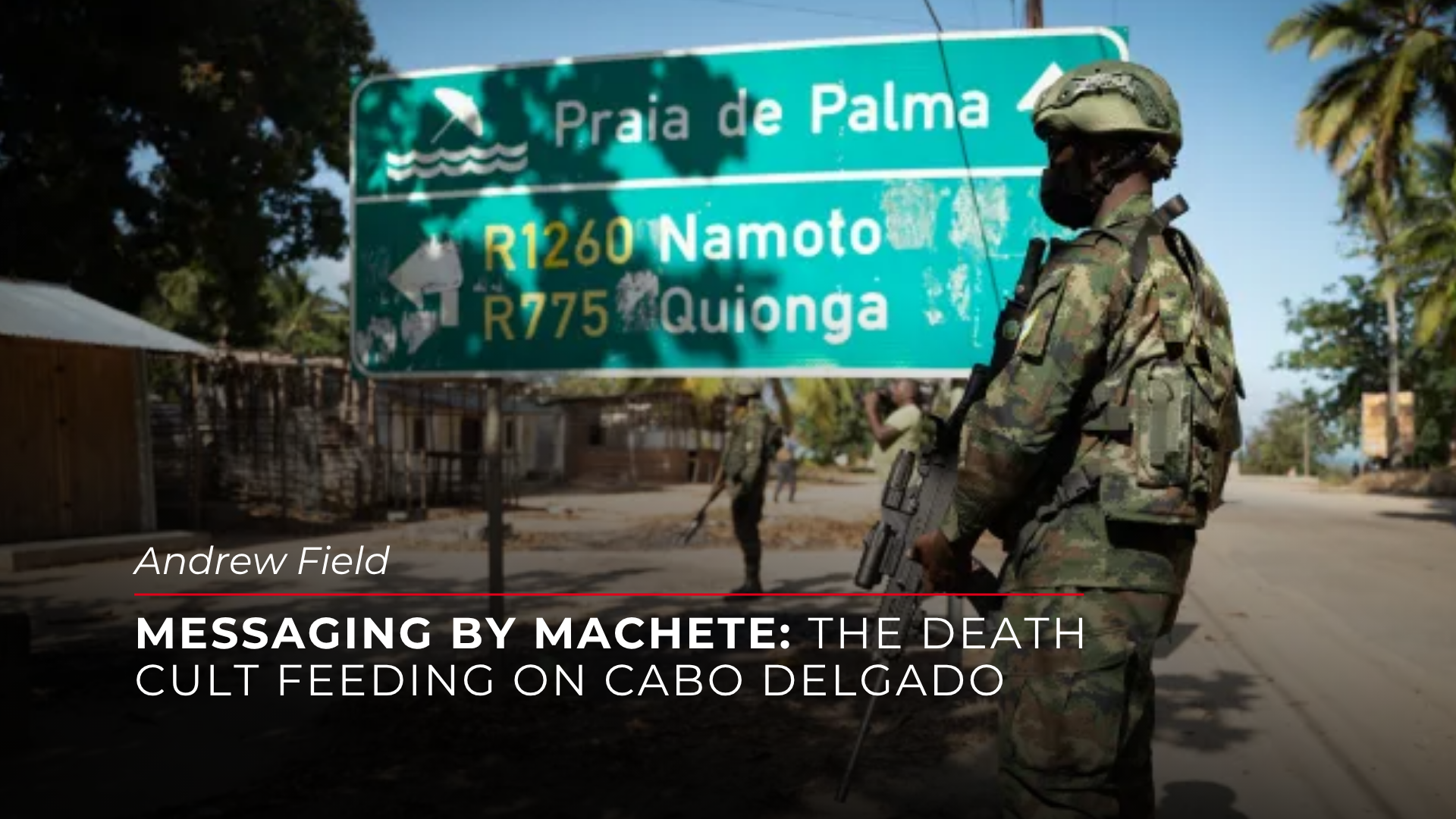
By Andrew Field
Mozambique is beginning to resemble a managed emergency rather than a counter-insurgency. The distinction matters because counter-insurgencies are supposed to end. Managed emergencies become permanent systems. They attract foreign missions, private contractors, aid agencies, training teams and diplomatic conferences, while the countryside itself quietly continues to burn. Cabo Delgado is now one of those places where everybody speaks carefully about “stabilisation” because nobody can honestly speak about victory.
The latest wave of attacks across April and May has exposed the fiction again. Villages torched in Nangade and Chiúre. Churches burned in Ancuabe. Passenger buses ambushed near Mueda. Artisanal gold miners kidnapped for ransom. Insurgents roaming through Macomia, Mocímboa da Praia, Meluco and Nangade almost at will. This is not the behaviour of a defeated movement. It is the behaviour of a movement demonstrating reach. The Islamic State Mozambique insurgency, still rooted in the Ahlu Sunna Wal Jammah network which first emerged violently in Mocímboa da Praia in 2017, has adapted rather than collapsed.
President Daniel Chapo inherited the conflict after taking office following Mozambique’s deeply disputed 2024 elections. The Frente de Libertação de Moçambique (Frelimo) retained power, as it has since independence in 1975, but the result’s legitimacy was visibly damaged when the Constitutional Council revised Chapo’s winning margin downward while raising opposition leader Venâncio Mondlane’s share. The unrest that followed reportedly killed more than 250 people nationally. Cabo Delgado therefore sits within a wider atmosphere of mistrust, economic strain and declining confidence in the state itself.
The insurgents understand this weakness perfectly. Their operations appear designed not to hold territory but to communicate power. The beheadings, church burnings and village raids are meant to spread fear, not to establish administration. Fighters enter a settlement, fire into the air, scatter the civilians, loot, burn, and vanish again into the forests and coastal corridors. The objective is psychological. Messaging by machete.
We should be clear about what that phrase describes before we admire its logic. It describes men who walk into a sleeping village, decide which of their neighbours will die, and saw the heads off those they choose. The Bishop of Pemba, António Juliasse, reckons some 300 Catholics have been murdered this way since the war began, and 117 churches reduced to ash. There is a temptation in writing about insurgency to treat atrocity as a variable in a strategy. It is not. It is the strategy’s foundation, and the strategy is evil to its root.
The ideology behind it deserves no quarter either. Islamic State offers the world a single product wherever it operates, and that product is subjugation. It promises the believer dominion and the unbeliever a choice between conversion, servitude and the blade. There is nothing local or particular about what is happening in Cabo Delgado. The same creed has burned Yazidi villages in Iraq, bombed Shia mosques in Afghanistan and gunned down concertgoers in Paris. It is a supremacist death cult that has never built anything, governed anything well, or left a single community richer than it found it. Mozambique has imported a franchise of that cult, and the franchise behaves exactly as the parent always does.
Here is the part that should anger anyone who cares about this province. The people of Cabo Delgado have real grievances and entirely legitimate causes. They are poor while sitting on gas worth tens of billions, beside rubies, graphite and gold, in one of the richest undeveloped territories in Africa. They are governed by a party that has held power since 1975 and an election the Constitutional Council itself quietly trimmed. They have every right to demand schools, clinics, jobs and a state that answers to them.
None of that is what Islamic State offers them. The insurgency does not advance a single one of those causes. It preys on the men who hold them, kidnaps them for ransom, burns their villages and recruits their sons into a project that will leave them poorer, more frightened and more cut off than before. Like the Sicilian Mafia that rose in the absent spaces of the Italian state a century ago, it offers protection from a threat that is largely itself, then bleeds the very people it claims to shield. It is a parasite wearing the costume of liberation. The grievance is real. The franchise feeding on it is a fraud.
That messaging has several audiences at once. The first is the rural population itself, particularly the Christian and non-Mwani inland communities who increasingly feel abandoned by the state. Archbishop Inácio Saúre described the destruction of the St Louis de Montfort Catholic mission at Minheuene, built in 1946, as “clear and strong messages of hatred against Christians.” He was correct. Churches are not merely tactical targets. They are chosen because a burning church terrifies the living and announces that faith itself is a capital offence in this province.
The second audience is the Mozambican state and its foreign backers. The overrunning of the military outpost at Mitope near Mocímboa da Praia humiliated the Forças Armadas de Defesa de Moçambique. Islamic State media circulated images of captured mortars and machine guns alongside photographs of government soldiers in T-shirts, unprepared for combat. The message was simple. Beyond a few defended zones, the state’s authority is thin.
The third audience is Islamic State itself. Modern jihadist insurgencies are media organisations as much as military ones. Every successful ambush, every burned church and every captured weapons cache becomes content for Amaq statements and al-Naba publications circulated through the wider Islamic State ecosystem. A provincial affiliate that disappears from the propaganda channels risks losing prestige, recruits and money. An attack that produces strong imagery has partly succeeded before the shooting ends. The murder, in other words, is the message, and the message is the product.
But ideology alone does not sustain insurgencies. Money does. The April raids on artisanal mining sites were revealing. At Ravia in Meluco district, insurgents remained for nearly six days processing gold-bearing material themselves. At Muaja they captured up to 80 miners and demanded ransoms reaching 50,000 meticais a head. Gold now appears central to the insurgency’s finances. Holy war funded by the kidnapping of poor men digging in the dirt is a revealing kind of holiness.
The money does not all stay local, and this is where the foreign hand becomes visible. Islamic State’s al-Karrar office in Puntland, Somalia, has long overseen transfers to its African affiliates. Researchers trace the flow through Uganda, the Democratic Republic of the Congo, South Africa and Tanzania, with cryptocurrency converted to cash at South African automatic teller machines and pushed onward by mobile money into Mozambique.
The weapons follow their own corrupted logic. Attacks aimed at stealing arms from Mozambican forces nearly doubled in 2025, which makes a poorly led national army one of the insurgency’s principal armourers. The franchise is fed from abroad and armed by the very state it is bleeding. Left unchecked, Cabo Delgado could harden into a permanent jihadist financing hub for the whole of Southern Africa, the way the Sahel became one for the west of the continent. That is the future being incubated while everyone discusses stabilisation. It is a real threat to the region.
The central irony is that while villages continue burning, international attention revolves around securing extraction enclaves rather than restoring provincial normality. TotalEnergies formally restarted work on its vast Mozambique liquefied natural gas (LNG) project at Afungi after lifting the force majeure imposed following the Palma attack in 2021. The project now resembles a fortified island defended by drones, surveillance and protected logistics routes. ExxonMobil’s Rovuma LNG project is edging back toward development, and Eni’s Coral South floating platform is already operational offshore. This is not stabilisation in any honest sense. It is securitised extraction, a province of defended perimeters rather than a recovered territory, with a fluid space between the nodes through which insurgents still move at will.
Rwanda remains central to this arrangement. President Paul Kagame’s government deployed troops in 2021 after Mozambican forces repeatedly failed to contain the insurgency, and its force grew from roughly 1,000 personnel to perhaps 6,000. Yet success brought complications. Rwanda’s role in eastern Congo and the allegations surrounding its support for the M23 rebellion collided with western politics.
Washington sanctioned elements of the Rwanda Defence Force and Brussels declined to renew the European Union funding that underwrote the mission. Foreign Minister Olivier Nduhungirehe responded by warning that Rwanda could leave if its efforts went unappreciated by the western governments benefiting from protected energy infrastructure. The truth beneath the diplomacy is plain. Rwanda guards strategic western commercial assets for a fragile host state that cannot even afford the bill, having fallen a year behind before agreeing on 19 May to fund the entire deployment alone.
That dependency is widening. China courted Chapo in Beijing in April, Kenya and the private military contractor Erik Prince, originator of Blackwater, are circling the same vacuum that Russia’s Wagner failed to fill in 2019, and a state that cannot secure its own territory ends up auctioning the job to whoever will take it.
Meanwhile ordinary Mozambicans remain trapped between propaganda and reality. The government insists the province is stabilising and cites the return of displaced populations as proof. Yet returnees are moving back into districts without schools, clinics, reliable security or functioning infrastructure. The insurgency has now touched sixteen of Cabo Delgado’s 17 districts. Only Pemba has escaped direct attack. That is hardly the profile of a pacified province.
The starkest illustration of the moral inversion came during the May clashes near Chiúre. The Naparama militia, largely local Makua men armed with machetes, bows and a belief in spiritual protection, pursued insurgents through bush terrain from before dawn until late afternoon. Twenty-seven of them were killed and buried in a mass grave. Mozambican security forces concentrated on protecting the district town rather than entering the bush fight. Consider what that scene shows. Foreign soldiers guard a gas plant for an oil major. Poorly armed villagers die in the forest defending their own homes. The men who killed them filmed it for distribution. There is no reading of that morning that does not end in condemnation.
The real danger now is not outright insurgent victory. It is something slower. A permanent condition of managed instability where enough security exists to protect the gas projects but never enough to restore normality. Foreign soldiers remain. Investors proceed cautiously. Villages empty and refill. Militants raid, film and recruit. The war never truly ends because too many systems have quietly adapted to its existence, and a system that has adapted to atrocity is a system that has agreed to tolerate it.
This is the equilibrium the killers are building, and it is the one the World must refuse to dignify. An Islamic State franchise that beheads farmers, burns the faithful inside their churches and ransoms miners has no claim on a single acre of this subcontinent. It is not a stakeholder in Cabo Delgado’s future. It is a cancer in its present. The insurgency no longer needs to conquer the province. It merely needs everyone else to grow used to the smoke. So the only question that matters is whether them SADC leadership, Maputo, Kigali, Brussels and the men behind the Afungi perimeter are quietly deciding they can live with that. And if they can, what does that make them?
Guest writer, Andrew Field, is the founder and author of the chronicle South of the African Equator and photoblog Simply Wild Photography
Discover more from Africa Unauthorised
Subscribe to get the latest posts sent to your email.

A very interesting analysis on a part of this World and a problem within it, that most non-African residents know Nothing about, and care Even Less about events, taking place in this part of their World.
Will they wake up and take note if the LNG, they so desperately need and crave, comes under the control of Radical Islamists ??